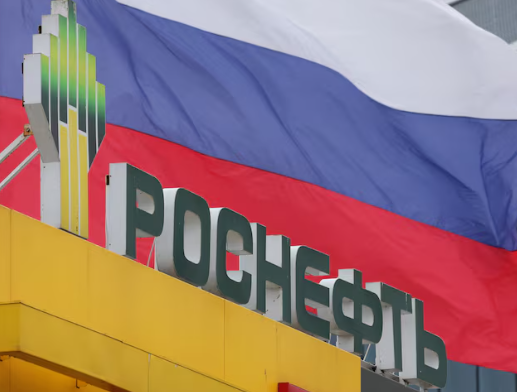
A Russian national flag flies behind a sign bearing the logo of Rosneft oil company installed at a fuel station in Saint Petersburg, Russia, October 23, 2025.
The broader trend of weaker oil prices throughout 2025 has put pressure on profitability across the global energy sector. Similar impacts have been reported in the most recent quarterly financial statements of international peers such as Shell (SHEL.L) and TotalEnergies (TTEF.PA), confirming that the challenge is industry-wide rather than company-specific.
In its official statement, Rosneft also pointed to rising operational costs linked to enhanced facility protection. The company referred to increased expenditure on "anti-terror security" measures but did not disclose further details regarding the nature or scope of these initiatives.
Total revenue for the January–September period amounted to 6.29 trillion roubles, marking a decrease of 17.8% year-on-year. The reduction reflects both lower realised hydrocarbon prices and the currency translation effect mentioned earlier.
"The high level of the Bank of Russia's key interest rate continues to have a significant negative impact on the profit. In addition, non-monetary and one-off factors adversely affected the indicator's dynamics during the reporting period," Rosneft explained in its release.
Another important profitability metric, earnings before interest, taxes, depreciation, and amortisation (EBITDA), stood at 1.6 trillion roubles for the nine months, representing a 29.3% decline compared to the previous year. Although the drop in EBITDA was less severe than the fall in net profit, it still underscores the combined pressure from financial expenses and operational challenges.
Despite the difficult financial results, Rosneft continues to maintain its position as one of the largest contributors to Russia's federal budget through taxes and dividends. The company remains focused on optimising costs, improving operational efficiency, and ensuring uninterrupted supply to both domestic and international markets under the current macroeconomic conditions.
The latest figures illustrate the complex environment faced by Russian oil and gas producers in 2025, where monetary policy tightening, volatile commodity prices, and additional security-related spending have converged to compress margins across the sector.