Stuttgart is one of the last places you’d expect to find in a power pinch. This south German city’s massive automotive plants run 24-7 without a hiccup, efficiency measures have held industrial power consumption flat, and solar panels flash from atop its major buildings. But now all that is at risk. The country’s accelerated shift from nuclear power and fossil fuels to renewable resources, such as wind and solar, has exposed a huge gap in its transmission capacity. If they are to survive, Stuttgart’s factories—and power consumers across southern Germany—will need to import a lot more power from the north, and Germany’s grid is already at capacity.?
To fill the gap, Germany is considering an aggressive plan that would push high-voltage direct current, or HVDC, from its conventional position on the periphery of AC grids to a central role. The primary reason is simple: For the first time, HVDC seems cheaper than patching up the AC grid. But Germany’s transmission planners also have another motivation: They want to provide as much performance and reliability as they can to an AC grid that’s already strained by excess wind power. For that, they’re considering implementing power electronics that are capable of doing something that’s never before been done on a commercial line: stop DC current in milliseconds flat. ?
As IEEE Spectrum went to press in early April, the €10 billion project was still being debated by the German parliament, but planning for the first HVDC line was already well under way. The project would start with the southern half of a 1000-megawatt, 660-kilometer line called Corridor A, to be strung from the North Sea port of Emden—a connection point for offshore wind farms under construction around Germany’s Borkum Island. It would end at an AC grid hub near the nuclear power station at Philippsburg, which lies 70 km northwest of Stuttgart. ?
If Germany moves forward with such HVDC lines, it could help pave the way for something much bigger, a “supergrid” of inter connected DC lines capable of transporting electricity on a continental scale, ferrying energy from North Sea turbines, dams in Scandinavia, or Mediterranean solar farms to wherever demand is greatest at that moment. The European Commission is counting on this sort of flexibility to meet its goal of an 80 percent renewable power supply by 2050. Corridor A could be the first step. ?
The idea for HVDC lines started to gain traction two years ago, when the Fukushima nuclear accident in Japan led German chancellor Angela Merkel to shut down 8 of her country’s 17 nuclear reactors and revive plans to phase out the rest of them by 2022. Although this will eliminate just 16 percent of the country’s annual electricity generation, the share comes to nearly half in the southern states of Bavaria and Baden-Württemberg, of which Stuttgart is the capital. Stuttgart will have to make up part of the loss by drawing on distant sources of wind power and fossil-fueled power plants. All told, some 10 gigawatts of power will need to be moved from northern to southern Germany once the last nuclear plant is closed. And the grid simply isn’t up to the challenge. ?
Renewable energy is already getting dumped because of it. In 2010, for example, German wind farms let some 127 gigawatt-hours of energy, enough to supply more than 30 000 German households for a year, fly on by. There was no grid capacity to deliver that power. The grid is so stressed that Bundesnetzagentur (BNetzA), Germany’s federal networks regulator, recently departed from typically dry language in its annual report [PDF] to warn that the accelerated shift from nuclear to renewables has “brought the transmission systems to the brink.” ?
Like many German cities, Stuttgart has a complex energy portfolio. The city generates one-eighth of its own electricity and gets most of the rest from elsewhere in Baden-Württemberg. Solar panels are the fastest-growing supplier in both the city and the state, thanks to premium prices set by the federal government. PV alone could account for as much as 18 percent of the energy produced in Baden-Württemberg by 2020.?
Little of that power will arrive in the winter, however, and none overnight. At the same time, solar generation is flattening peak power prices, undermining the profitability of natural gas and coal power plants. The Düsseldorf-based power company E.ON blamed the weakened market last November when it mothballed two natural-gas plants and shelved plans for a state-of-the-art coal plant; all happen to be in the south.?
![Illustration: Bryan Christie Design. Source: www.entsoe.eu? Cutting Across the Grid: Germany’s transmission-system operators have proposed four HVDC lines (along three corridors) that would cut across the country’s AC grid and help ship power from the wind-rich north to the south, which is more reliant on nuclear energy. In 2011, Germany shut down eight of the country’s nuclear reactors [red dots]. The nine remaining reactors [blue dots] are slated to cease operating by 2022.](http://www.yliwu.com/uploadfile/2021/0730/20210730030432194.png)
Using less coal and natural gas is a key plank in Germany’s response to climate change. But the pace of change is unsettling for BNetzA, which oversees the power grid and counts on fossil-fuel plants that deliver power on demand to maintain its stability. BNetzA is so concerned that for the past two winters it has paid owners of several older gas-fired power plants in southern Germany and Austria to keep their plants on standby.?
In principle, wind power in the south could take up some of the slack—but not much. Winds are generally slower in the south. Turbine construction to exploit what wind is available requires clearings and roads, and Germany’s celebrated Black Forest is defended tooth and nail by local communities. Expanding the south’s power storage capabilities with extra pumped storage has also met with resistance from environmental groups, which argue that building new hydropower reservoirs would destroy habitats.?
Add it all up and there appears to be no ready means of meeting the south’s needs other than bringing more power from the north. That would include a sizable amount of wind power, which already accounts for 8 percent of the country’s electricity consumption and is expected to nearly double by 2022. ?
Germany’s transmission system operators (TSOs), which operate the regional grids, have been eyeing major upgrades in the AC grid since 2005. That’s when the German Energy Agency published an analysis showing that variable renewable energy flows were already at risk of overloading the country’s grid. Whereas conventional power plants generated power close to where it was needed, the grid was increasingly moving renewable energy from wherever it was in surplus to whatever regions could use it. To add capacity, the agency called for a modest 5 percent expansion: 850 km of new ultrahigh-voltage AC lines, to be completed by 2015. ?
The plans didn’t stay modest. In 2010, the agency found that the country would need an additional 3600 km of new AC lines by 2020 to handle the growth in wind and solar power. That’s a daunting number given that stiff local opposition has stymied construction of all but 214 of the 850 km called for in 2005. The ballooning estimates are only partly due to the accelerating shift to renewable power. They are also exacerbated by the physics of AC grids. Germany’s grids, like most worldwide, are essentially single circuits, formed by a mesh of interconnected high-voltage lines. Electricity flows freely across the grid following a path of least resistance, one that shifts from moment to moment as power plants across the country (and Europe) ramp up and down and as millions of homes, businesses, and factories use appliances and machines. ?
Getting more power from point A to point B in an AC grid often requires building more than just one line to ensure that wandering power flows do not overload the grid’s weakest paths. Although some newer technologies can help nudge AC electricity down particular lines [see “Flexible AC Transmission: The FACTS Machine,” Spectrum, January 2011], they’re expensive to implement on large scales.?
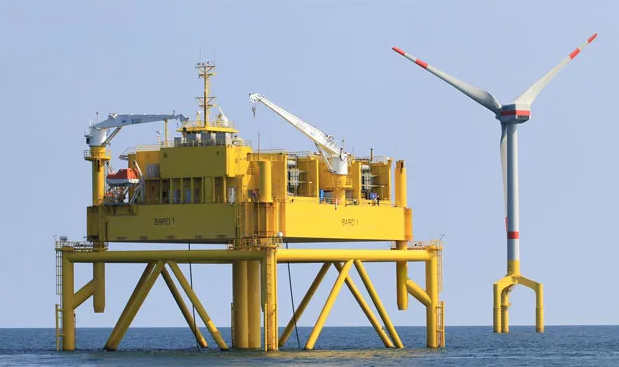
HVDC offers a comparatively elegant solution. Thanks to power electronics placed at either end, a single HVDC line can act as a high-capacity electrical wormhole, pulling electricity from close to its point of generation and reinjecting it into the AC grid hundreds or thousands of kilometers away. The direction and magnitude of the power transmitted on a line can be precisely controlled, something that’s impossible to do for an AC line within the grid’s wide-open circuit. The power electronics needed to make this happen can push the cost of a single HVDC line well above that of an AC line. But when Germany’s TSOs totaled up all the costs, they found that a DC system would be a less expensive way to enable the country’s shift toward renewables, primarily because fewer lines have to be built or upgraded. ?
One factor that has made HVDC particularly attractive is improvements to electronic converters—the units at either end of the line that transform AC current into DC current, and vice versa. Classic HVDC lines use converters built from thyristors, which are efficient but limited in their capabilities. Those converters rely on the AC system to support their operation. As a result, classic HVDC is typically chosen nowadays for long-haul lines moving loads of stable power, such as hydropower, that is relatively easy for the AC network to absorb. ?
In the late 1990s, Swiss-Swedish engineering giant ABB commercialized more sophisticated and compact converters, built from high-frequency silicon insulated-gate bipolar transistors (IGBTs). These “voltage source converters” (VSCs) control their own voltage and can thus help stabilize the AC grid around them. In an HVDC line using these advanced converters, hundreds of IGBTs connected in series fire synchronously to channel power from the AC line and rectify it into steady current for the DC line. The converter at the downstream end of the line performs a similar process to convert the current back into AC. At the same time these IGBT-based converters can watch for and correct voltage dips or surges on the AC lines. That has made them popular in applications such as linking offshore wind farms where shifting power levels require dynamic regulation of voltage at the AC connection point. ?
These capabilities ignited hope that HVDC could escape its niche status and challenge AC transmission for jobs at the heart of power grids. But the IGBT-based converters still had three hurdles to overcome before they could challenge AC technology. One was a capacity ceiling of a few hundred megawatts. Another was switching losses of about 1.5 to 2 percent of transmitted power per converter, which made them costly to use. For a line carrying power from a thousand offshore wind turbines, such converters would throw away the output of 15 to 20 of those multimillion-dollar machines. ?
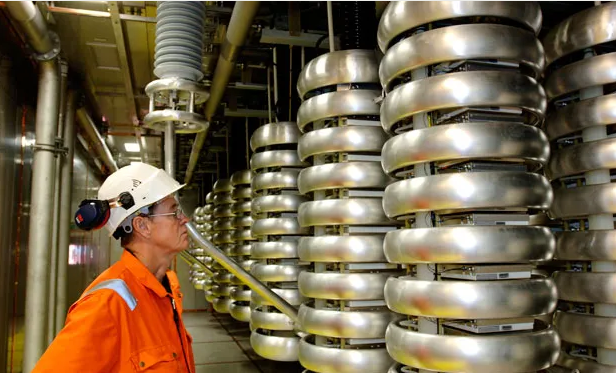
In 2010, Siemens commercialized a novel IGBT converter that cleared those two hurdles. These so-called modular multilevel converters gang together several hundred miniconverters, or “submodules,” to push the overall converter capacity from a few hundred megawatts to 1000 megawatts or more—the scale that Germany’s TSOs are looking for. Each submodule fires only when it’s needed to contribute to the conversion to or from a variable AC wave, cutting switching losses to just 1 percent per converter. ?
Rising power and efficiency have made the technology particularly attractive to Germany’s TSOs, which have pushed modular multilevel converters to the top of their list. But to get the performance and stability they want for Corridor A, they say they’ll need to overcome VSC technology’s ultimate Achilles’ heel: its inability to break DC current. ?
To avoid complex route planning and minimize opposition, the TSOs have sketched a route that would build the HVDC line down existing AC corridors, using the very same towers—a first for VSC-based lines. A long, exposed DC line is a large target for lightning, tree strikes, and other disruptions. Given the central role that Corridor A and three other planned DC lines will play in an already strained grid, the TSOs are hunting for an advanced HVDC converter that can tolerate or quickly recover from faults. ?
What’s needed is advanced HVDC equipment that’s capable of stopping the flow of high-voltage DC current so that a line can be quickly reset and rebooted. This isn’t a problem with AC lines—even ultrahigh-voltage ones—because the voltage zeroes out every time the current reverses direction: 100 times per second on Europe’s 50-hertz grids. Any one of those zero points is a natural spot to interrupt the circuit without creating a damaging arc. Direct current, however, just keeps pumping. Stopping it quickly and at high voltage is like slamming a gate in front of a speeding truck. “In DC, you always have full energy. If you tried to break a DC line with a mechanical breaker...it would just burn up the switchgear,” says Claes Rytoft, chief technical officer for ABB’s power systems division. ?
Today’s modular multilevel HVDC converters can’t help, because of a design quirk that actually feeds DC faults. Those converters are assembled from submodules that contain a pair of IGBTs, a pair of diodes, and a DC capacitor. The diodes are the problem component during DC faults. In normal operation, they dynamically reconfigure the submodule circuitry to handle the alternating positive and negative voltage coming from the AC grid. During a DC fault, however, current arcs over the diodes and connects the submodules’ positive and negative terminals, creating internal short-circuits. ?
Existing HVDC lines with IGBT-based converters get around their breaking problem by relying on the AC grid to shut the converters down. To clear a fault on a DC line, a speedy AC breaker upstream can cut off the current in less than 100 milliseconds. This sounds fast, but it’s only a small step toward restarting the line. The system must wait half a second to close the AC breaker after the fault is cleared, says ABB’s Rytoft, in order to reset the converters. And it can take up to 2 seconds for the converters to return to full power, he adds. While this works fine when HVDC lines are handling a few hundred megawatts, a line like Corridor A would shunt a tsunami of excess energy into the AC grid. And with the HVDC converter shut off, it could offer the AC grid no help in handling the disturbance.?
The most straightforward solution is to redesign the AC-DC converter submodules to function as breakers. One design fix that would work is already applied in some lower-power DC units: doubling the number of IGBTs to create a “full-bridge submodule.” The full-bridge’s two extra IGBTs give the circuit more flexibility, enabling it to repurpose its capacitor to fight a fault. In normal operation the capacitor acts primarily as a short-term energy buffer. But during faults on the DC line, the full-bridge’s extra switches can reconfigure the circuits so that the voltage across the capacitor, and thus the submodule, opposes the voltage on the DC line, resulting in zero current flow. In February, the French power equipment supplier Alstom demonstrated a converter incorporating full-bridge submodules that extinguished DC currents exceeding 3000 amperes in less than 2.5 milliseconds—up to 40 times as fast as an AC breaker. And the converter never turns off, so it can stabilize the AC grid and is ready to pump DC at full power once a fault is cleared. ?
But the penalty that comes with this speed boost may be substantial. Because full-bridge submodules use twice as many IGBTs as those in existing modular converters, they are less efficient, returning losses from each converter of as much as 1.7 percent. “It is a trade-off between losses and security of supply,” acknowledges Thomas Ahndorf, senior manager for system analysis at Stuttgart-based TransnetBW, the TSO for Germany’s southern grid.?
Ahndorf says he will pay the full-bridge’s efficiency penalty if he must, but he may not have to. HVDC innovators are racing to demonstrate smarter options. Alstom’s approach is to limit losses by substituting only some of the multilevel converter’s 2-IGBT submodules with full-bridge submodules. And in November, ABB demonstrated an entirely novel solution to efficient HVDC breaking: a stand-alone breaker that would sit on the HVDC line and be used along with the standard, two-IGBT converter. It couples a mechanical switch with two electronic breakers. In normal operation, electricity passes through the mechanical switch and the smaller of the two breakers. When the system detects a fault, the smaller breaker has just enough heft to start the breaking sequence, applying voltage to its IGBT gates to raise its resistance. That briefly shunts DC power through the larger breaker, which contains enough IGBTs to break the current. When the current switches over, the mechanical breaker is triggered, physically disconnecting the default path. Then the larger breaker cuts off the alternate path, squelching the DC current. According to ABB’s Rytoft, it’s all over in less than 5 milliseconds—much faster than the blink of an eye. And, says Rytoft, operating the larger current-stopping circuit solely during faults all but eliminates the efficiency penalty. ?
Power engineering heavyweight Siemens, meanwhile, is collaborating on a third option with Rainer Marquardt, chair for power electronics and controls at the University of Federal Defense, in Munich, and inventor of the modular multilevel converter. Marquardt’s scheme is to connect two of the submodules that he invented for Siemens’s VSC converters with a fifth IGBT. This “double submodule” can reorient capacitors to stop DC current, just as a full-bridge module does. But because only three of the five IGBTs are conducting current at any given moment, it loses one-third less power than a full-bridge converter. This solution might be considerably cheaper than ABB’s stand-alone breaker, as it can function as both a converter and a breaker. Marquardt estimates that installing a separate breaker such as ABB’s next to each converter on an HVDC line could increase its component costs by up to 50 percent, while his design could be comparable in cost and footprint to today’s VSC converters. ?
All of the HVDC innovators are poised to move fast. Alstom plans to test its design at higher current within months. Siemens has not revealed its plans for Marquardt’s design, but Marquardt says it won’t be hard to implement, because his new submodules are essentially a drop-in replacement for those Siemens already sells. And ABB is seeking a utility partner to test its system, which it plans to have ready for a first commercial application for 2017. ?
That might be just in time for Corridor A, which is already in the public consultation phase and is set to begin carrying power in 2017. TransnetBW’s Ahndorf says the corridor is on a “very tough schedule,” but keeping it is critical if all the grid extensions are to be constructed by 2022. “We have to learn. We have no time to lose,” he says.?
HVDC innovators are already looking ahead to what they see as the technology’s natural conclusion: HVDC grids that can optimize the flow of power between countries and across continents. “Most experts in this field have long said that it is very doubtful that this would be realistic,” Marquardt says. They have more confidence now, he says, since such supergrids are likely to need both advanced converters and stand-alone breakers, units that the German TSOs are helping to drive forward. ?
Supergrid backers say the need for HVDC grids, meanwhile, is already evident in the increasingly unmanageable cross-border flows on AC grids. The Czech Republic is installing phase-shifting transformers at its border with Germany, for example, to keep its neighbor’s renewable energy from looping through the Czech grid, which is at its carrying limit. Such rogue flows are a growing phenomenon across continental Europe, says Sébastien Lepy, head of grid development studies for RTE, France’s TSO, which is also eyeing more central HVDC lines.?
In principle, a European supergrid would make it easy to coordinate a range of far-flung sources of renewable energy, and it could be cheaper than revamping each country’s grid one by one. Large-scale grid schemes are already being seriously studied. A three-year project called E-Highway 2050, for example, is creating a modular scheme for linking up HVDC lines such as Corridor A to form a European supergrid. And the German Commission for Electrical, Electronic & Information Technologies is drafting technical standards for HVDC grids. ?
But some TSOs are skeptical that supergrids are urgently needed. “Point-to-point is a very good result. You don’t need a DC grid yet,” says Ahndorf, who is a member of the German electrotechnical commission’s HVDC grids working group. The benefits, he says, are still unclear. For now, German transmission planners like Ahndorf are just trying to get the first HVDC lines built. They’re keenly aware that the clock is ticking. The plan will need to be approved, financed, and then built, one line at a time. Years could slip away in negotiations with opponents of each line.?
And the stakes are high. Projections by the Berlin-based energy think tank Agora Energiewende suggest developers can bump up the generating capacity of renewable installations to 130 GW by 2022 from the roughly 75 GW in place at the close of last year. Without the ability to carry that power where it’s needed, that would be a hollow victory for the green energy movement. ?
This article originally appeared in print as “Germany Jump-starts the Supergrid?.”
About the Author
Paris-based contributing editor Peter Fairley traveled to Stuttgart last November to report on Germany’s bold HVDC plan. The weather was bitter cold and very dark, he says, which made it “chillingly clear” that the boom in solar power wouldn’t make up for the coming closure of the region’s nuclear plants—at least not year-round. “Fixing the grid will keep all of Germany on track,” he says.