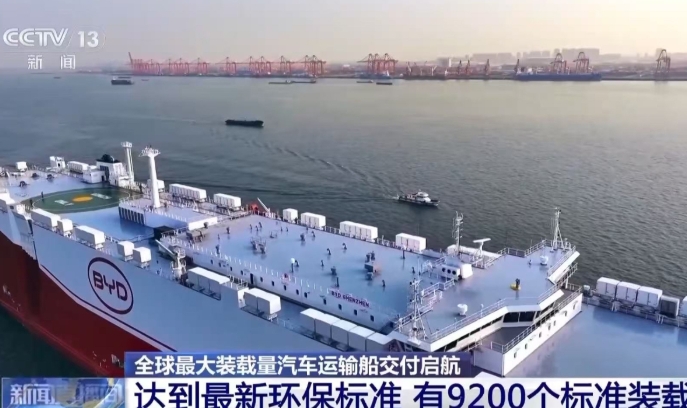
The Shenzhen measures 219.9 meters in length and 37.7 meters in width, with 16 decks capable of carrying up to 9,200 vehicles, making it the largest car carrier currently in operation. It incorporates advanced LNG dual-fuel technology, energy-efficient main engines, a recondensing system, and other eco-friendly features, achieving 37% greater carbon efficiency than the International Maritime Organization’s latest environmental standards.
Operated by BYD, a leading Chinese electric vehicle manufacturer, the Shenzhen is the company’s fourth large car carrier. The vessel supports the increasing global demand for vehicle exports, which reached over 5 million units from China last year, as noted by Fu Bingfeng, executive vice-president and secretary general of the China Association of Automobile Manufacturers, in a CCTV report.
Cui Dongshu, secretary general of the China Passenger Car Association, stated on his official WeChat account on Tuesday: “Brazil is not only among the top 10 destinations for China's vehicle exports in 2025 but also ranked in the top 10 for new energy vehicle exports during the first quarter of the year.” He highlighted Belgium, Mexico, Brazil, and Southeast Asian countries as key markets for new energy vehicles in 2025.
The Shenzhen’s advanced design and green technology reflect BYD’s commitment to sustainable maritime transport, aligning with the global shift toward cleaner energy solutions. Its capacity to transport thousands of vehicles efficiently supports China’s growing role in the international automotive market.
The delivery of the Shenzhen marks a significant milestone for BYD and China’s vehicle export industry. The vessel’s journey to Brazil underscores the strong demand for Chinese-manufactured vehicles, particularly new energy vehicles, in major global markets. By leveraging cutting-edge technology, the Shenzhen enhances the efficiency and environmental performance of vehicle transportation.
This development highlights the expanding infrastructure supporting China’s automotive exports, with the Shenzhen playing a pivotal role in delivering vehicles to key regions. The focus on markets like Brazil and Southeast Asia reflects strategic efforts to meet diverse global needs for sustainable transportation solutions.