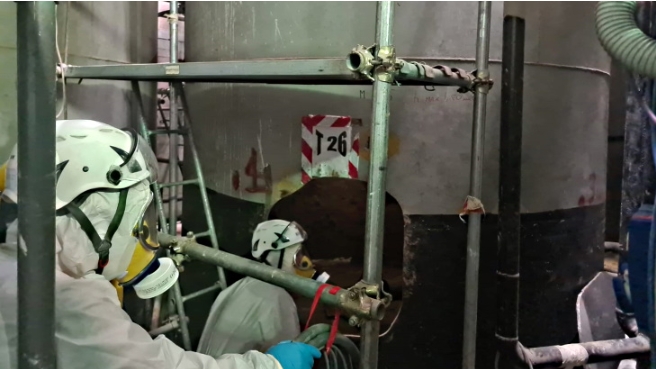
The redundant system, located in the RW building across two floors and four rooms, includes supply and discharge pipes, three tanks—emptied of sludge in 2023—and supporting equipment. Societa Gestione Impianti Nucleari SpA (Sogin), established in 1999 to oversee the decommissioning of Italy’s former nuclear sites and manage radioactive waste, is leading the project. Sogin and its subsidiary Nucleco have upgraded the building’s electrical, ventilation, and radiological monitoring systems to ensure safety during the dismantling process.
The operation, expected to conclude by the end of 2025, employs advanced cutting robots designed specifically for the task. These robots are remotely operated by technicians to handle the most complex components safely. A Sogin spokesperson noted: “This project reflects our commitment to safe and efficient decommissioning while minimizing environmental impact.”
Approximately 50 tonnes of metallic material will be removed during the dismantling. After smelting and decontamination, only about 15 tonnes of radioactive waste are expected to remain. This waste will be stored in temporary on-site depots until it can be transferred to Italy’s national repository once it is operational. Sogin’s approach emphasizes reducing the volume of radioactive waste, aligning with its broader waste management strategy.
The Garigliano plant, a 150 MWe boiling water reactor, began generating electricity in January 1964 and ceased operations in 1982. Italy, which once operated four nuclear power plants starting in the 1960s, decided to phase out nuclear energy following a referendum after the 1986 Chernobyl accident. The country’s last two plants, Caorso and Trino Vercellese, closed in 1990.
To support ongoing decommissioning at Garigliano, Sogin introduced the new liquid effluent treatment system in 2022, ensuring continuity of operations. The dismantling of the old system marks a significant step in safely managing Italy’s nuclear legacy while adhering to modern safety and environmental standards.