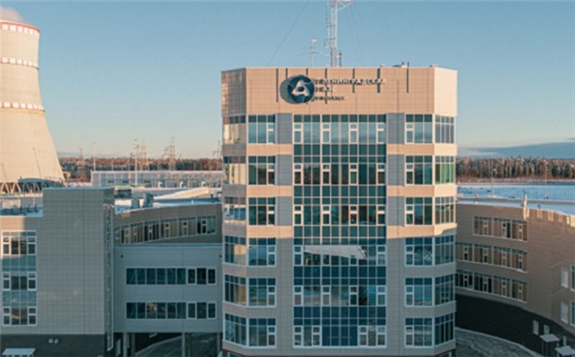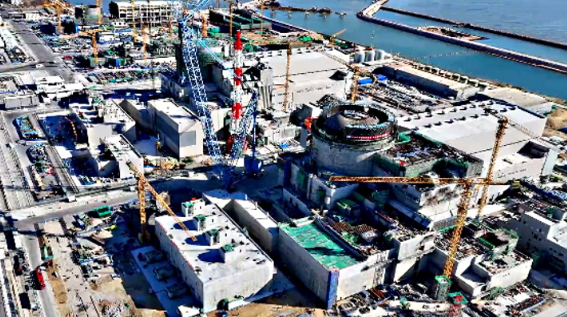
The construction site of Xudabao units 3 and 4
The passive water tank forms a key part of the reactor's safety system. In case of primary circuit leakage, it enables the steam generators to operate in condensation mode, returning condensate to the core for continuous cooling without external power. The completed tank for unit 4 consists of four large modules incorporating reinforced concrete, stainless steel lining, 33 penetrations, and 16 heat exchangers. Each module weighs 325.9 tonnes.
CNNC stated that the installation "marks the full completion of the modular construction of large components for the second phase of the Xudabao nuclear power project, which lasted four years". Since the first hoisting of unit 3's core shaft module on 18 November 2021, the project team has applied extensive modular construction techniques, including a pioneering "four-in-one" combined lift of the containment steel liner, through-hole components, steel truss, and horizontal steel mesh. Advanced finite element analysis and virtual simulation achieved millimetre-level precision, significantly enhancing safety and quality.
The Xudabao Phase II comprises two VVER-1200 reactors (units 3 and 4), with construction starting in July 2021 and May 2022 respectively. Commercial operation is planned for 2027 and 2028. Units 1 and 2 will feature domestically developed CAP1000 reactors, following issuance of their construction licence in November 2023. Two additional CAP1000 units are proposed for a future Phase III.
The plant is owned by Liaoning Nuclear Power Company Ltd, in which CNNC holds 70 percent, Datang International Power Generation Company 20 percent, and State Development and Investment Corporation 10 percent.
The successful completion of modular construction at Xudabao unit 4 demonstrates mature application of advanced building techniques for VVER-1200 reactors and provides valuable experience for future nuclear projects in China.