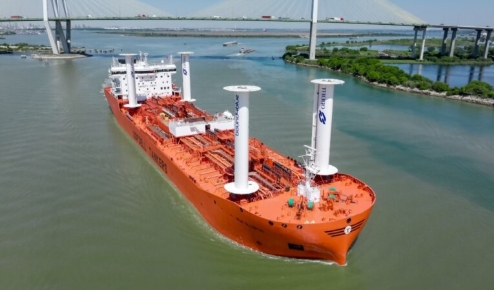
The vessel, a five-year-old 49,000 dwt tanker, is equipped with four 22-meter eSAIL suction sails installed by Spanish company bound4blue in March 2025. These sails, tested across two Atlantic voyages, have performed effectively under various weather conditions. Odfjell’s crew and technology team have monitored their impact. Erik Hjortland, Odfjell’s Vice President Technology, stated: “The results have surpassed our expectations.” He noted that in moderate wind conditions, the sails achieved a 15-20% energy-saving effect, saving five tons of fuel daily and reducing CO? emissions by 15 tons per day. On some segments, fuel consumption dropped by up to 40%.
An AI-based weather routing system optimized the vessel’s path to leverage wind conditions, revealing that even light winds at a 15-degree angle to the bow provided noticeable benefits. Hjortland added: “One surprising finding is that even light wind as high as 15 degrees on the bow generates noticeable effect. This means that we can probably operate the sails more often than anticipated, positively affecting the already healthy return of investment figures.” The sails also stabilize the vessel and reduce roll.
Complementing the sails, Bow Olympus uses 100% sustainable biofuel sourced from certified waste materials, requiring no technical upgrades. This dual approach achieves an 85% reduction in greenhouse gas intensity compared to conventional fuels, with sails improving energy efficiency by 15-20%. As the vessel nears European shores, it showcases a viable path to near-net-zero operations for deep-sea shipping.
Odfjell has improved its fleet’s carbon intensity by over 53% since 2008 through 140 energy-saving devices. With conventional upgrades largely exhausted, the company now explores innovative solutions like wind propulsion to meet its 2030 goal of 57% carbon intensity reduction. A fuel switch will be necessary for further progress, and Odfjell is keeping options open. Hjortland concluded: “We will now drill into the data, assess the lessons learned, and use the experience as a foundation to decide our next steps.” The voyage highlights a practical approach to sustainable shipping, adaptable to varying conditions and vessel types.