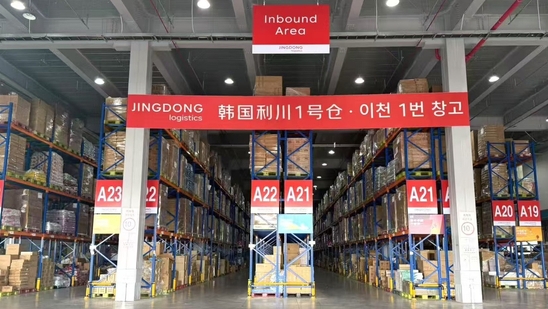
JD.com's Icheon logistics center in Icheon, Gyeonggi
Founded in 1998 in Beijing by Richard Liu Qiangdong, JD.com has grown from a small electronics shop into one of China’s top retailers, ranking 47th on Fortune’s Global 500 list last year with revenue of 1.16 trillion yuan ($162.4 billion). The company’s strategy involves building robust logistics infrastructure before launching full retail operations, a model it previously applied in Thailand and Indonesia. The Korean logistics network is seen as a foundation for a broader e-commerce presence in a competitive market.
Unlike other Chinese platforms, JD.com emphasizes product authenticity, directly inspecting merchandise and offering tenfold compensation for counterfeit items. A company spokesperson stated: “JD.com has built its reputation on guaranteeing authentic products.” This direct purchase model, similar to Amazon and Coupang, positions JD.com to address consumer trust concerns in Korea, where reliability is a key factor in e-commerce.
JD.com’s logistics capabilities include a dense warehouse network in China, enabling same-day and next-day delivery. The company leverages big data to optimize inventory and employs drones and autonomous robots for deliveries in remote and urban areas. In Korea, JD.com aims to replicate this efficiency, focusing on high-value products like electronics and home appliances, categories where Chinese brands such as TCL, Roborock, and Xiaomi are gaining popularity.
Jeon Byung-seo, head of the China Economic and Finance Research Institute, noted: “There are already cases where negative perceptions of Chinese products have been overcome through product quality, such as with Roborock’s robot vacuum cleaners.” However, challenges remain, including securing prime logistics real estate in the Seoul metropolitan area. A distribution industry source commented: “To enhance logistics efficiency, JD.com would need to secure prime real estate, but there are very few sites left.”
JD.com’s move into Korea reflects its focus on global expansion amid competitive domestic and international markets. The company, which established a Korean subsidiary in 2018, aims to leverage its logistics expertise and product authenticity to capture a share of Korea’s advanced e-commerce market, offering premium goods and rapid delivery services.