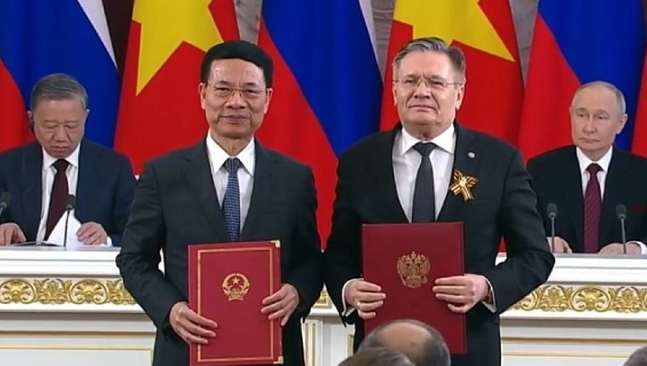
The agreement was signed during the presidential meetings
During the discussions, Rosatom Director General Alexey Likhachev and Vietnam’s Science and Technology Minister Nguyen Manh Hung signed an Interdepartmental Roadmap for Nuclear Technology Development to 2030. This roadmap includes plans for a nuclear science and technology center featuring a research reactor, fuel supplies for the existing Dalat research reactor, and workforce training. It also involves Vietnamese participation in a research center at the MBIR fast neutron reactor under construction in Dimitrovgrad, Russia.
Likhachev highlighted the historical cooperation, stating: “For many decades, the flagship of our cooperation has been work in the research field. In the 1980s, Soviet specialists restarted a research reactor built by the Americans (Dalat), and now Vietnamese specialists have ordered a new research reactor from us. We have already entered a site in the south of the country, in the province of Dong Nai, not far from Ho Chi Minh City.” He added that the new reactor could become the most advanced in Southeast Asia and noted progress toward a large-scale nuclear power plant project using Russia’s VVER-1200 reactor.
The joint statement emphasized: “Both sides affirmed the importance of accelerating the project to build a Nuclear Science and Technology Centre in Vietnam as well as training Vietnamese students at educational institutions in Russia in the fields related to the use of atomic energy for peaceful purposes.” It also underscored the commitment to renewable and clean energy cooperation, ensuring compliance with nuclear and radiation safety standards for socio-economic development.
Vietnam’s Prime Minister Pham Minh Chinh, in February, directed state-owned groups to complete two nuclear power plants by 2030. A previous plan for VVER-1200 reactors in Ninh Thuan, approved in 2009, was paused in 2016 due to economic factors but was revived by the National Assembly last November. The recent agreements aim to provide Vietnam with sustainable energy, stimulate economic growth, create jobs, and develop a skilled workforce.
To Lam, General Secretary of Vietnam’s Communist Party’s Central Committee, stated: “We will work to develop new, substantial, and effective breakthroughs in scientific research and technology, nuclear energy, biotechnology, and the semiconductor industry.” The partnership seeks to foster joint research and innovation, enhancing Vietnam’s energy and technological capabilities.