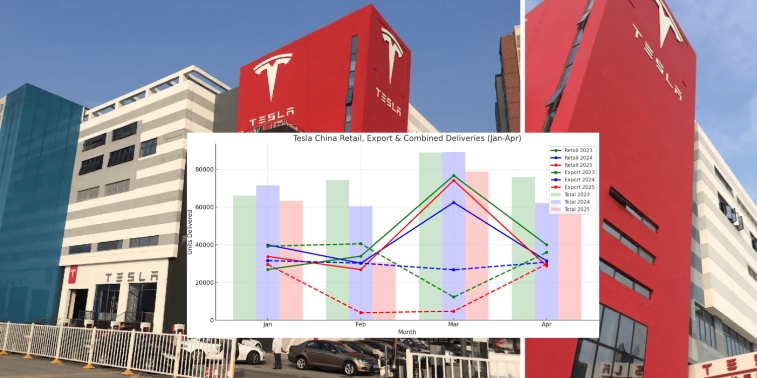
The company attributed its weak first-quarter performance in 2025 to the production transition for the revamped Model Y, which temporarily limited supply. Although production stabilized by April, both domestic sales and exports remained lower than in April 2024, which had already seen a significant decline from 2023. Tesla’s January-to-April sales in China reflect the company’s most challenging start in three years, despite offering substantial discounts and incentives.
The updated Model Y, launched in China on January 10 with deliveries starting February 26, contributed significantly to Tesla’s sales, with 19,984 units sold domestically in April, accounting for 69.56% of Tesla’s retail sales in the country. However, Model Y retail sales dropped 24.18% year-on-year, as exports of the model rose sharply to 13,976 units, a 149.3% increase from the previous year. This shift toward exports partially explains the domestic sales decline, as Tesla prioritizes international markets early each quarter.
Fred Lambert, Editor-in-Chief at Electrek, noted: “It certainly had an impact, but Electrek previously reported that Tesla quickly discounted vehicles in China despite benefiting from the launch of the updated Model Y – pointing to deliveries being lower due to demand on top of the limited Model Y supply in the first quarter.” These discounts, including a five-year zero-interest financing offer for Model Y buyers through June 30, reflect Tesla’s efforts to stimulate demand amid growing competition.
Chinese automakers are intensifying competition by offering competitively priced electric vehicles with improving quality and performance. While the Model Y remains Tesla’s top seller, new rival models are challenging its market position. Tesla’s overall market share in China’s battery-electric vehicle segment fell from 8.4% in April 2024 to 5.1% in April 2025, highlighting the competitive pressure.
Tesla’s Shanghai factory, a key production and export hub, completed the Model Y capacity ramp-up in just six weeks, setting a new efficiency record. Despite this, the company faces challenges in maintaining its growth trajectory in China, with total sales from January to April 2025 down 18.31% compared to the same period in 2024.