


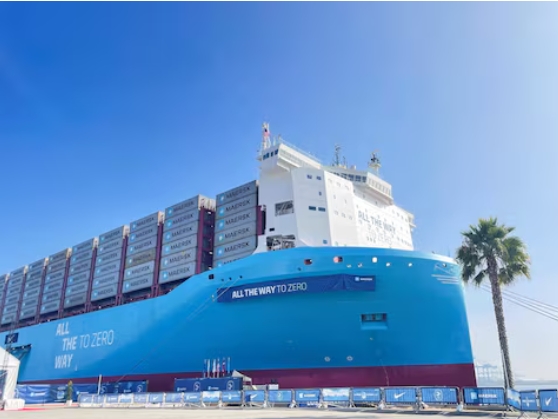
The Alette Maersk, a green methanol-powered ship, is seen docket at the Port of Los Angeles, in Los Angeles, California, U.S., August 27, 2024.
The facility uses renewable energy and captured CO2 from biogas plants and waste incineration to produce e-methanol, a sustainable alternative to traditional methanol derived from natural gas and coal. Maersk, operating 13 dual-fuel methanol container vessels and with 13 more on order, will be a key customer. The plant’s yearly output can fuel one large 16,000-container vessel on Asia-Europe routes or power smaller vessels like the Laura Maersk, the world’s first dual-fuel container ship, which requires 3,600 tons annually and was scheduled to refuel near Kasso on Tuesday.
Emil Vikjar-Andresen, head of European Energy’s Danish Power-to-X team, stated during a webinar: “When you look at the production from Kasso, it is of course just a literal drop in the ocean, so we need to scale up and we need to bring costs down.” The high cost of zero-emission fuels like e-methanol, compared to conventional fuels, remains a challenge due to limited production scale. Maersk is exploring green fuel technologies and efficient shipping methods to reduce expenses.
Beyond shipping, e-methanol from the Kasso plant will support other industries. Companies like Novo Nordisk and Lego will use it to produce injection pens and plastic bricks, respectively, replacing fossil-based methanol. Additionally, excess heat from the production process will supply heating to 3,300 local households, enhancing community benefits.
The plant’s launch aligns with global efforts to meet the International Maritime Organization’s goal of eliminating carbon emissions from shipping by 2050. The Kasso facility marks a step toward scaling up sustainable fuel production to meet growing demand while supporting diverse applications and local sustainability.
