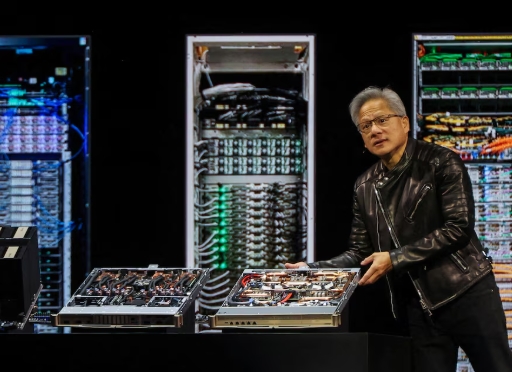
Nvidia CEO Jensen Huang delivers the keynote for the Nvidia GPU Technology Conference (GTC) at the SAP Center in San Jose, California, U.S. March 18, 2025.
Based on Nvidia’s RTX Pro 6000D server-class graphics processor, the new chip will use conventional GDDR7 memory instead of advanced high-bandwidth memory and will not incorporate Taiwan Semiconductor Manufacturing Co.’s Chip-on-Wafer-on-Substrate packaging technology. These design choices result in simpler manufacturing and lower performance specifications, aligning with the reduced price point. Chinese brokerage GF Securities noted that the GPU may be named the 6000D or B40, though it did not provide pricing details.
An Nvidia spokesperson stated: “Until we settle on a new product design and receive approval from the U.S. government, we are effectively foreclosed from China’s $50 billion data center market.” The chip’s specifications, pricing, and production timeline remain subject to final approval, and Nvidia is exploring its limited options to comply with regulations.
China represents a significant market for Nvidia, contributing 13% of its sales in the past financial year. However, Nvidia’s market share in China has declined from 95% before 2022 to 50% today, largely due to U.S. export restrictions. Nvidia CEO Jensen Huang highlighted that the older Hopper architecture, used in the H20, can no longer be modified to meet these restrictions, necessitating the development of new chips.
Nvidia is also working on another Blackwell-architecture chip for China, with production planned for September 2025, though its specifications are not yet confirmed. The new GPU’s memory bandwidth is forecasted at approximately 1.7 terabytes per second, within the 1.7-1.8 terabytes per second cap set by recent U.S. regulations, compared to the H20’s 4 terabytes per second.
The April 2025 ban on the H20 led Nvidia to abandon plans for a downgraded version, resulting in a $5.5 billion inventory write-off and $15 billion in lost sales, as Huang shared on the Stratechery podcast. Despite these challenges, Nvidia aims to maintain its presence in China’s data center market by offering cost-effective, compliant solutions to meet demand for AI processing.