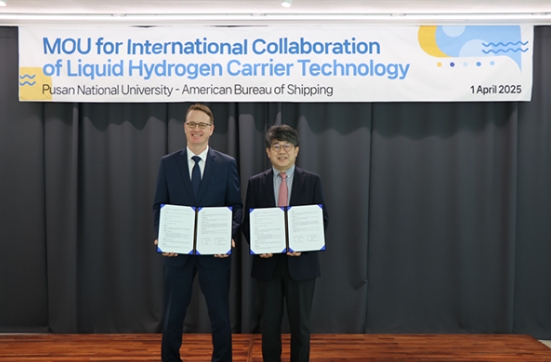
Transporting liquefied hydrogen, stored at -253°C, presents significant technical challenges and has yet to be commercialized successfully. Patrick Ryan, ABS Senior Vice President and Chief Technology Officer, stated: “The newly established collaboration can deliver advances in application of hydrogen technology at sea, including liquid hydrogen carriers.” The partnership aims to address these challenges by leveraging cutting-edge cryogenic technology to support the growing hydrogen economy.
Lee Jae-Myung, Director of the Hydrogen Ship Technology Center, commented: “The cooperation between our university and ABS will be an important turning point for further advancement in the utilization of liquid hydrogen, a key field of the future hydrogen economy, through differentiated international exchange activities based on world-class, ultra-low temperature technology. We will make joint efforts to create synergy in the development of ultra-low temperature research, an unexplored field of human society.” The collaboration focuses on developing innovative solutions for hydrogen transport and storage.
Pusan National University’s Hydrogen Ship Technology Center leads the “Development of Basic Technology for Commercialization of Liquid Hydrogen Carriers” project, a key part of South Korea’s “K-Shipbuilding Super Gap Vision 2040.” This initiative, supported by a KRW 2 trillion (approximately $1.45 billion) investment from the South Korean government and private sector, includes 10 flagship projects such as ammonia-fueled ships, liquid hydrogen carriers, and electric propulsion vessels. The center is spearheading efforts to develop the world’s largest liquefied hydrogen carrier, with a demonstration ship targeted for completion by 2027.
The project supports South Korea’s efforts to strengthen its shipbuilding industry and expand clean energy solutions for domestic and international use. By advancing liquid hydrogen carrier technology, the collaboration contributes to sustainable energy innovation and regional economic growth without affecting consumption or trade dynamics.