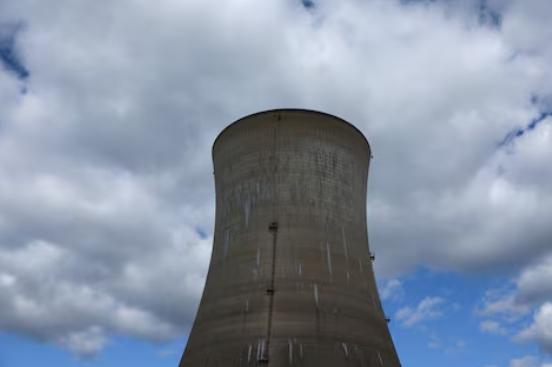
A cooling tower is seen at the Three Mile Island Nuclear power plant, during a tour by Constellation Energy in Middletown, Pennsylvania, U.S., October 16, 2024.
Last September, Constellation secured a 20-year power purchase agreement with Microsoft to supply energy for its data centers, enabling the revival of the plant, which ceased operations in 2019 due to economic challenges. The reactor targeted for restart was not involved in the 1979 partial meltdown that impacted the nuclear industry. Constellation CEO Joe Dominguez, speaking at an event on Three Mile Island, said: “We made a mistake in shutting down this plant, but we’re not here to dwell on the past.”
The facility remains in a condition similar to when it closed in 2019. Since the restart was announced, Constellation has focused on planning, hiring, and infrastructure preparation. The company has ordered critical components, such as the main transformer and fuel, and restored water systems essential for operations. Inspections required for permitting have also been completed. Dominguez added: “When PJM gets this connected, we’re going to be ready.”
The restart aligns with growing demand for reliable energy, driven by the technology sector’s expansion, particularly for artificial intelligence. Nuclear power is experiencing renewed interest across the U.S., with projects like the Palisades plant in Michigan also pursuing restarts and New York planning a new nuclear facility, the first in decades.
Hundreds of Constellation employees attended the announcement event, joined by PJM CEO Manu Asthana and Pennsylvania Governor Josh Shapiro, who advocated for expediting the project’s approval. Shapiro emphasized the plant’s role in the state’s future, stating: “I am focused like a laser beam on the future of Pennsylvania and the future runs through places right here like Crane.” The Crane project is among the largest fast-tracked by PJM to address grid connection delays, a common bottleneck for power projects amid rising data center demand.
Constellation has hired over 400 workers for the plant, including 30 operators currently in training for control room roles. The Nuclear Regulatory Commission is scheduled to visit in July 2025 to review the training process. While the project’s progress is promising, nuclear power initiatives have historically faced delays and cost overruns, making the 2027 target ambitious but significant for energy reliability and sustainability.