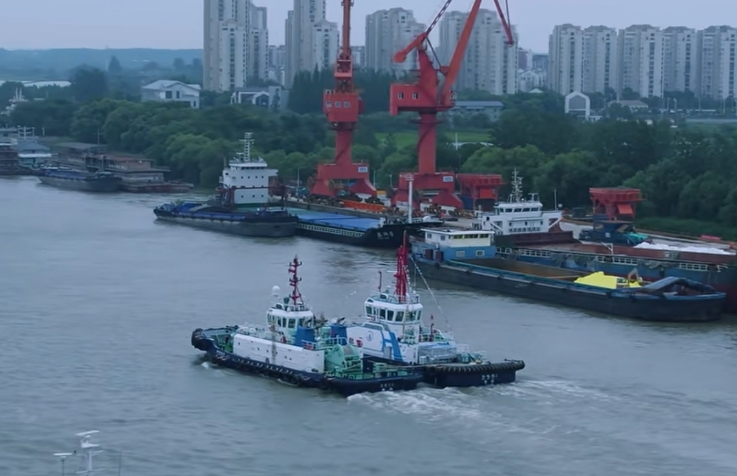
The tugboat is the most powerful of its kind in China, equipped with the largest lithium battery capacity among similar vessels. It utilizes CATL's cutting-edge marine energy solution to achieve zero-carbon emissions, establishing a model for environmentally friendly port operations.
Tugboats are essential for guiding large vessels, such as cargo ships and tankers, into position at ports. As global ports move toward greener practices, battery-powered tugboats like this one are becoming vital to reducing environmental impact.
The Hydrogen Electric Tug No. 1 features a high-performance battery system with a capacity of 7,838.88 kWh, offering the highest energy density in China at 140 Wh/kg and a peak output of 5,200 kW. This enables the tugboat to operate for over 12 hours at a cruising speed of 9 knots, with a maximum bollard pull of 82 tonnes, ensuring reliable performance in challenging marine environments. CATL's innovative technology, including its non-thermal diffusion system, advanced battery management, and precise liquid cooling controls, ensures safety and efficiency during operations.
A CATL representative stated: "Our marine energy solutions are designed to support the transition to zero-carbon ports, and this tugboat demonstrates the reliability and performance of our technology."
Once fully operational, the tugboat is projected to cut carbon dioxide emissions by 1,500 tonnes annually, contributing significantly to Qingdao Port's ambition to become a zero-carbon facility.
CATL is expanding its efforts in sustainable marine solutions. In addition to this tugboat, the company has powered vessels like the Greater Bay Area No. 1, a hybrid luxury catamaran, and the Yangtze River Three Gorges No. 1, the world's largest fully electric cruise ship. These projects support decarbonization across various maritime sectors, including tourism, harbor operations, and freight shipping.