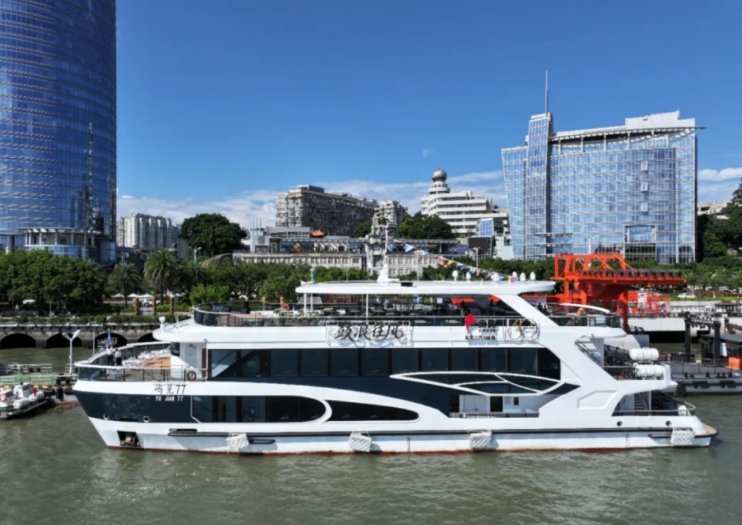
The Yujian 77’s battery system, developed by CATL, utilizes advanced cell-to-pack (CTP) technology and an integrated Combined Charging System (CCS) design. This configuration achieves an energy density exceeding 140Wh/kg, enhancing efficiency. With a total battery storage capacity of 3,918kWh, the ship can travel 100km, sufficient for four consecutive night cruises in Xiamen Bay.
Safety is prioritized with no thermal propagation (NP) technology, which prevents thermal runaway at the cell level. The system meets IP68 standards for water and dust resistance and has passed a 1,296-hour salt fog test, ensuring reliable performance in demanding maritime environments.
The Yujian 77 is projected to reduce annual fuel consumption by approximately 250 tonnes and cut carbon dioxide emissions by over 400 tonnes, equivalent to the environmental benefit of planting more than 20,000 trees. This supports sustainable maritime tourism and reduces environmental impact.
Certified by the China Classification Society (CCS) as the first domestic all-electric maritime tourism passenger ship, the Yujian 77’s battery system has also received approvals from global classification societies, including Bureau Veritas (BV), American Bureau of Shipping (ABS), and Det Norske Veritas (DNV). These certifications validate the system’s safety and reliability for international maritime applications.
CATL stated: “We plan to continue our technological innovations, developing even safer, longer-lasting, and higher-energy-density marine battery systems, with the aim of further accelerating the transition to a zero-carbon future for maritime transport.” The company is committed to advancing sustainable solutions for the maritime industry.
The launch of the Yujian 77 marks a significant step in promoting eco-friendly maritime transport. By integrating cutting-edge battery technology, CATL and the Yujian 77 demonstrate the viability of electric systems in reducing emissions and enhancing the sustainability of coastal tourism operations.