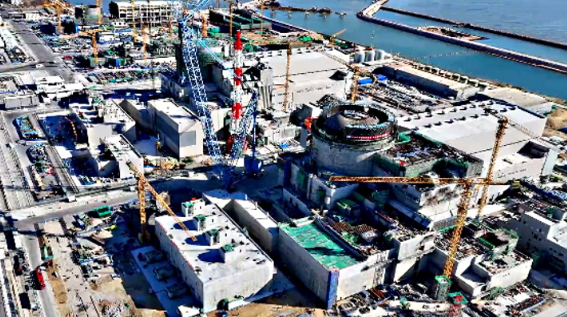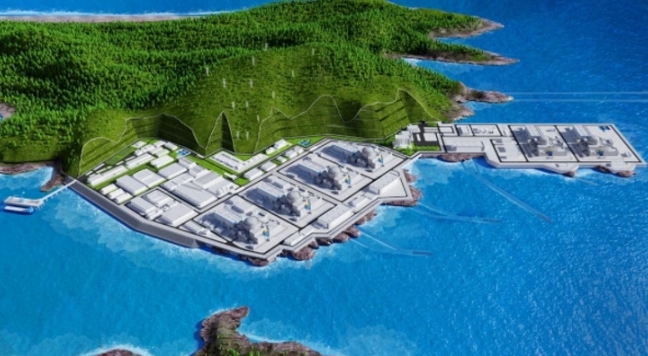
A rendering showing the proposed layout of the six-unit Jinqimen plant
The project will feature two 1200 MWe Hualong One reactors in its first phase. The construction of these units was approved by the State Council on December 29, 2023. A ground-breaking ceremony was held in February 2024, signifying the official launch of the project.
The NNSA stated: "We believe that the submitted application documents comply with relevant national laws and nuclear safety regulations, and that the design principles and nuclear safety-related activities of units 1 and 2 of the Zhejiang Jinqimen Nuclear Power Plant meet the requirements of China's nuclear safety regulations."
The project is being led by CNNC Zhejiang Energy Co Ltd, a subsidiary of China National Nuclear Corporation (CNNC), which is responsible for investment, construction, and operational management. The full site will eventually comprise six Hualong One units.
Following a recent inspection, the NNSA confirmed readiness for the next construction phase. The agency informed CNNC Zhejiang Energy: "Our inspection team conducted an on-site inspection of the nuclear island preparations for unit 1 of the Zhejiang Jinqimen Nuclear Power Plant. We concluded that all on-site preparations are in place for the pouring of the first concrete for the nuclear island foundation. Your company may proceed with the pouring of the first concrete for unit 1's nuclear island foundation."
Once all six reactors are operational, the total installed capacity of the Jinqimen nuclear power plant is expected to reach approximately 7.2 GWe. According to CNNC, the plant will be capable of delivering around 55 TWh of electricity annually to the grid. This output is projected to contribute significantly to carbon emissions reduction, with an estimated decrease of about 50 million tonnes of carbon dioxide each year.
The Jinqimen project is part of China's broader strategy to expand nuclear power generation and support clean energy development. Further progress on the remaining four units will be planned in phases, aligning with national energy goals and safety standards.