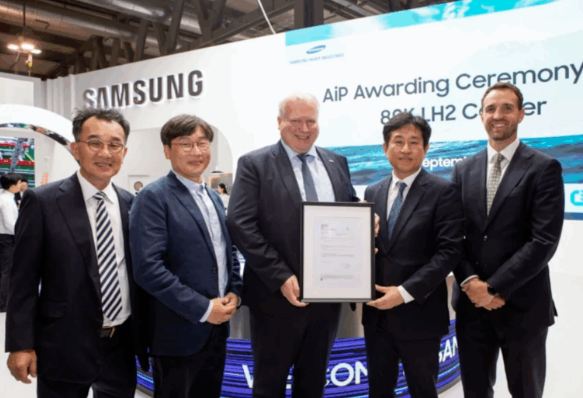
According to the company, the LH2 carrier design adopts a vacuum-insulated Type C tank system integrated with a reinforced hull and supporting structure, enabling safe operations under extreme cryogenic conditions. Among the features of the new design are spherical tanks optimized to reduce overall size and weight. In addition, the inner and outer tanks are connected using glass fiber-reinforced plastic (GFRP) supports, which help prevent heat transfer and reduce cargo losses caused by boil-off gas during transportation.
CS Bang, Vice President of SHI, stated: “Receiving DNV’s AiP is a testament to our engineering capabilities and vision for hydrogen transport. We believe this vessel will play a vital role in building a global hydrogen supply chain.”
Vidar Dolonen, DNV’s Regional Manager for Korea & Japan, remarked: “Building confidence in new technologies and new energy solutions, begins with building trust. By working closely together with innovative and future focused partners like SHI, utilizing our expertise and leading rule set, we can lay the groundwork for the next generation vessels that will be needed for the energy transition. We are proud to present them with this AiP and support the development of technologies that help to enable the transport of clean energy.”
The approval represents a significant step for SHI as it positions itself in the emerging hydrogen shipping sector. With growing interest in hydrogen as a clean energy source, large-scale LH2 carriers are expected to play an important role in global supply chain development.
Separately, DNV has been active in various initiatives supporting innovation and sustainability in the maritime and energy industries. Recently, the classification society renewed its memorandum of understanding (MoU) with the Singapore Institute of Technology (SIT), extending their cooperation in areas such as maritime education, applied research, and new technology development.
DNV also secured three-year inspection contracts for two of the UK’s first carbon capture and storage (CCS) projects. These agreements involve providing quality assurance services, reflecting the society’s growing role in supporting decarbonization initiatives across different sectors.
Additionally, DNV conducted a technical review of HYPRPlant, a turnkey electrolyzer system developed by U.S.-based manufacturer Electric Hydrogen. The review confirmed the solution’s compliance with current standards for process design, safety, and manufacturing, further underscoring DNV’s role in evaluating and verifying emerging clean energy technologies.
Through these developments, both SHI and DNV demonstrate their commitment to advancing solutions for the transport and production of clean energy. The AiP for SHI’s liquefied hydrogen carrier design marks an important milestone in building reliable infrastructure to support the future global hydrogen economy.