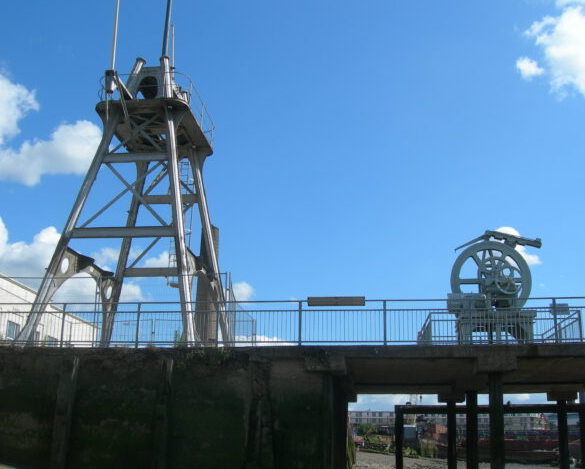
The machinery, integral to the production and deployment of undersea cables, played a pivotal role in global telecommunications history. It is notably linked to TAT-1, the first transatlantic telephone cable system, established between 1955 and 1956, which connected the UK and North America, revolutionizing international communication.
“We take instant global communications, text messages, pictures, and voice, for granted in 2025, but this place in Greenwich is where it all started, way back in the middle of the 19th century,” said Alan Burkitt-Gray, former editor of Capacity Media, who advocated for the designation to Historic England.
The site’s significance traces back to the 1850s when the Telegraph Construction and Maintenance Company (Telcon) operated from nearby Enderby House. Telcon was instrumental in producing and laying the first successful transatlantic telegraph cables in the 1860s, enabling rapid communication between Europe and the Americas. This legacy underscores Greenwich’s role as a hub for telecommunications innovation.
The designation enhances the recognition of a cluster of sites in Greenwich and the Isle of Dogs tied to the development of global connectivity. Across the Thames, the Great Eastern, designed by Isambard Kingdom Brunel and launched in 1858 as the world’s largest ship at the time, was later used to lay transatlantic cables and parts of the UK–India route, further cementing the area’s historical importance.
Enderby House, now a riverside pub, was preserved from disrepair two decades ago through efforts by the Enderby Group, a local campaign organization. The group noted: “The new designation recognises Greenwich’s enduring contribution to the evolution of international communications infrastructure.”
This recognition highlights the importance of preserving industrial heritage that shaped modern connectivity. The protected equipment at the Submarine Cables Ltd factory stands as a testament to technological advancements that laid the foundation for today’s global communication networks.
By safeguarding this site, the DCMS and Historic England aim to honor its contribution to telecommunications while ensuring future generations can appreciate its historical value. The designation strengthens Greenwich’s legacy as a cradle of innovation, linking its past achievements to the interconnected world of today.