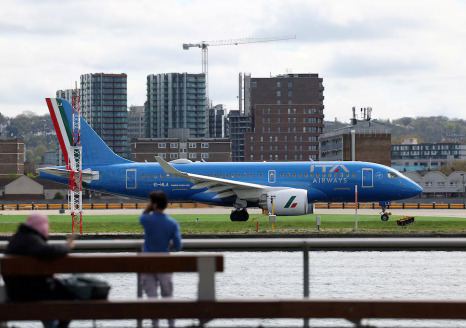
People watch as an ITA Airways Airbus A220-100 takes off from London City Airport in London, Britain, April 11, 2024.
Chief Executive Officer Guillaume Faury told reporters that Airbus still aims to eventually reach the higher rate but did not specify a timeline. He said: “We are not dropping the rate of 14 a month, but we will target 12 instead of 14 next year,” while acknowledging that this “doesn’t answer the question of when we will reach the higher rate.”
According to a Reuters report published earlier in the week, Airbus had already delayed assembly of several A220s for 2024 and 2025, setting an internal goal of producing 12 aircraft per month by mid-2026, with 14 a month penciled in for late that year. However, that schedule is no longer part of Airbus’ detailed production plan. The company has previously indicated that a rate of 14 aircraft per month is required for the A220 program to reach profitability. The current output is estimated at around 7 to 8 aircraft monthly.
Despite the adjustment, Airbus reported strong financial results. In the third quarter, adjusted operating profit rose 38% to 1.94 billion euros ($2.26 billion), supported by a 14% increase in revenue to 17.83 billion euros. These results exceeded analysts’ forecasts, which had predicted a core profit of 1.76 billion euros and revenue of 17.37 billion euros. The company reaffirmed its financial outlook for the year, including the impact of tariffs.
Airbus maintained its production goals for other aircraft models, including a target to build 75 of its best-selling A320neo jets per month by 2027, up from about 60 currently. It also reaffirmed its plan to deliver approximately 820 commercial aircraft in 2025, noting that engine supply constraints had eased somewhat during the third quarter. So far this year, Airbus has delivered 507 aircraft, though Faury said deliveries for 2025 would remain “very backloaded.” The company currently has a backlog of 32 assembled aircraft awaiting engines, down from a peak of 60.
In its defense division, Faury addressed progress in the Franco-German-Spanish fighter jet project, reiterating that Airbus remains committed while urging its partner Dassault Aviation (AM.PA) to cooperate under the agreed work structure. Dassault, which leads the fighter development, has called for clearer leadership roles, while Airbus is responsible for the unmanned systems component. Dassault was not available for comment.
Separately, Boeing (BA.N) reported a third-quarter adjusted loss of $7.47 per share and took a $5 billion charge related to delays on its 777X program, highlighting contrasting performance trends between the two aerospace giants.