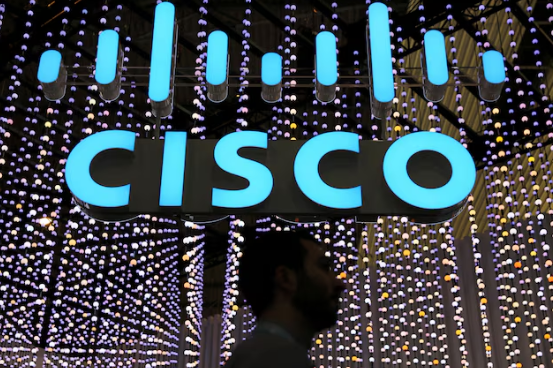
A man passes under a Cisco logo at the Mobile World Congress in Barcelona, Spain February 25, 2019.
Shares of Cisco rose more than 7% in extended trading after the announcement, adding to a 25% gain so far this year. The company, a key supplier to cloud service providers, enterprises, and communication networks, has benefited from increased investment in digital infrastructure as businesses accelerate cloud migration and integrate AI technologies.
Cisco CEO Chuck Robbins said during a post-earnings call that the company expects $3 billion in AI infrastructure revenue from hyperscalers in fiscal 2026, following more than $2 billion in AI orders secured for fiscal 2025. Robbins added: “We are seeing a growing pipeline in excess of $2 billion for our high-performance networking products across sovereign, neocloud and enterprise customers.”
The company forecast fiscal 2026 revenue between $60.2 billion and $61 billion, higher than its previous estimate of $59 billion to $60 billion. Annual adjusted earnings per share are now projected at $4.08 to $4.14, compared with an earlier forecast of $4 to $4.06. Cisco’s first-quarter revenue reached $14.88 billion, surpassing analysts’ expectations of $14.77 billion, according to data compiled by LSEG.
AI infrastructure orders from hyperscalers totaled $1.3 billion in the quarter ending October 25, reflecting the strong investment momentum in data centers and network upgrades. Industry leaders such as Alphabet, Microsoft, Meta, and Amazon have all indicated plans to increase capital spending to support AI and high-performance computing systems, further fueling demand for Cisco’s advanced networking products.
Analysts said Cisco is well positioned to benefit from this trend. Ryan Lee, senior vice-president of product and strategy at Direxion in New York, commented: “While the networking business is rather mature, Cisco is seeing nice sales catalysts via the AI boom and some product refreshes.”
Earlier in November, Cisco introduced a new computing platform called “Cisco Unified Edge,” designed to run AI workloads locally at retail outlets, manufacturing facilities, and healthcare centers. The platform extends AI computing beyond centralized data centers, aiming to improve processing efficiency and performance at the network edge.
With strong financial guidance and expanding AI-related opportunities, Cisco is preparing to capture a larger share of global infrastructure investment driven by artificial intelligence. The company’s strategic focus on hyperscaler partnerships and advanced networking technology underscores its role in supporting the next generation of digital and AI-driven connectivity.