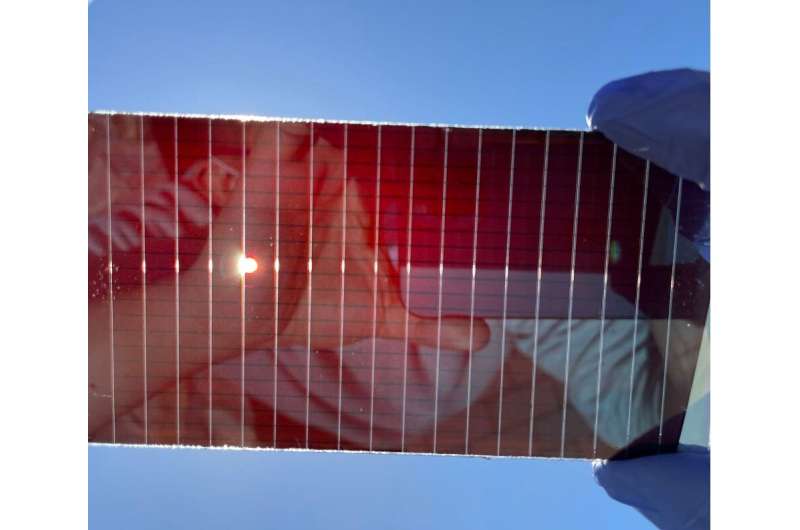
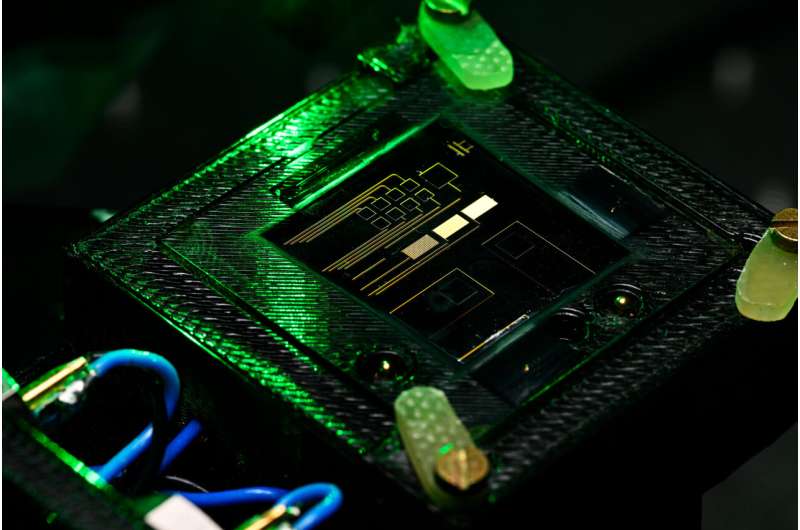
The next generation of solar cells, made from flexible, wearable material, may soon charge our devices on the go, or provide critical electricity when other power sources are not available, like during a natural disaster.
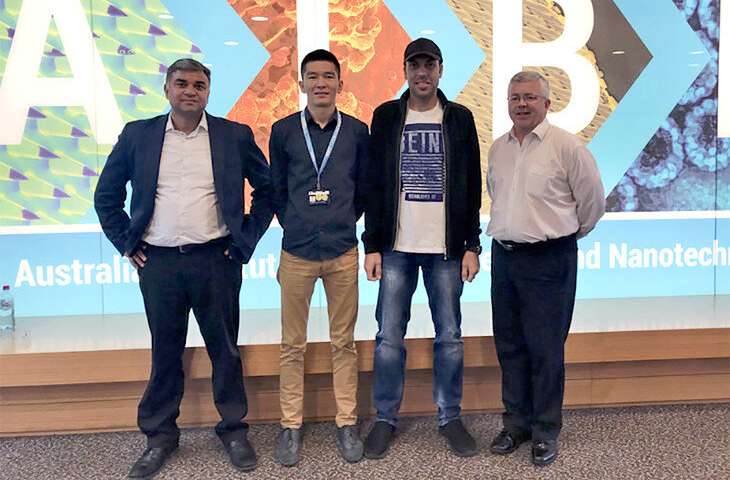
An international team of scientists from Penn State and the University of Queensland, Australia, are developing new technology to help make these next-generation solar devices a reality.
"With this technology, you can put an efficient, flexible solar patch on your shoulder and walk around in the sun and have a cell phone charging in your pocket," said Shashank Priya, professor of materials science and engineering and associate vice president for research at Penn State. "The flexibility and integration with common surfaces offer a new dimension for how we use solar energy."
A long list of potential uses for flexible solar cells exists, but hurdles remain before the technology can compete with more traditional, rigid solar panels and other energy sources.
"I think defining a very good problem is actually the first stage of making a big discovery," Priya said. "In the case of solar, there are three big problems, and they are well-defined—improving efficiency and stability and lowering cost."
To address these challenges, Priya collaborates with Joe Shapter, a professor at the University of Queensland, Australia whose laboratory specializes in nanotechnology.
Priya and members of his laboratory are world-leaders in designing and manufacturing paper-thin, flexible solar cells from next-generation solar materials. Shapter and his team research cutting-edge nanomaterials, such as carbon nanotubes and phosphorene, that can further boost the performance of solar cells like those Priya creates at Penn State. This collaboration may result in the next generation of commercially viable solar cells.
"There is little doubt that we have to find ways to produce the energy we need in ways that are not damaging to the environment," Shapter said. "In parts of the world where there is significant sunlight, solar photovoltaics present a clear opportunity to do this."
Collaboration in action
Half a world away from home, Liam Brownlie watched as flexible solar material rolled off a printer on the Penn State University Park campus.
Brownlie, a graduate student in Shapter's laboratory, spent the last year at Penn State on a Fulbright Scholarship, lending his expertise in nanomaterials and chemistry, and strengthening the relationship between the two research groups.
"My work with Joe Shapter, and now here at Penn State enables me to work with front-end, cutting-edge, solar cell technology," Brownlie said. "A lot of people are just starting to understand how to print new-generation materials and Shashank's group is the best in the world at doing this kind of stuff."
Using the technology, homeowners could someday stick solar patches on curtains or wallpaper to absorb stray sunlight and power electronics that once relied on batteries. The military could place the patches on tents during forward deployments or in responding to natural disasters that have destroyed power grids.
"Modern science relies on collaborations like this," Brownlie said. "It's these collaborations and sharing of knowledge and skill and really helps keep science moving forward."
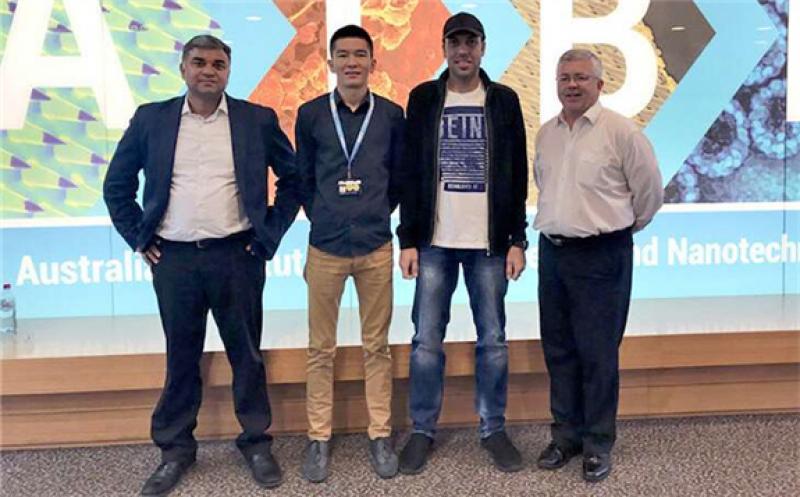
Priya and Shapter first met at a U.S., Australia joint conference in Washington, D.C., organized by the Air Force Office of Scientific Research (AFOSR). They said the partnership leverages both groups' strengths and has accelerated the development of solar technology.
Their collaboration has resulted a series of papers published in Nano Energy, Joule and Small Methods that provide advancements in improving the stability and performance of solar cells.
"International research collaborations like this strengthen science," said John Hellmann, senior associate dean for graduate education and research in the College of Earth and Mineral Sciences at Penn State. "We can learn from each other and share resources; by harnessing the intellectual horsepower among our collaborators, we can reduce the time necessary to make critical scientific advances."
The future of solar
Traditional solar cells, typically rigid devices found on roofs or solar arrays, have steadily improved over the past several decades, and today can convert about 20 to 22% of the sun's energy into usable electricity. However, scientists believe they are approaching the limits of silicon-based technology.
Recent work has focused on perovskite solar cells, named for their unique crystal structures that excel at absorbing visible light. Perovskite cells are an area of intense research because they offer a more efficient and less expensive alternative to traditional silicon-based solar technology.
Shapter's team is researching 1D and 2-D materials to improve efficiency and stability of perovskite cells and is developing new nanomaterials that can improve electron transport inside the cells. His team is using phosphorene, a 2-D material that is essentially a single layer of black phosphorus molecules.
"The longer-term goal is to make photovoltaics that do not use silicon," Shapter said. "Our main focus has been on an 'all carbon' solar cell, which would be cheap to produce, and we think can have very high efficiencies."
Materials like phosphorene are currently experimental and therefore costly, but Priya said they could eventually be cheaper to produce commercially than silicon is today.
"In order to move further, we need new materials like phosphorene and 2-D perovskite single crystals," Priya said. "These are the next steps to moving technology forward."