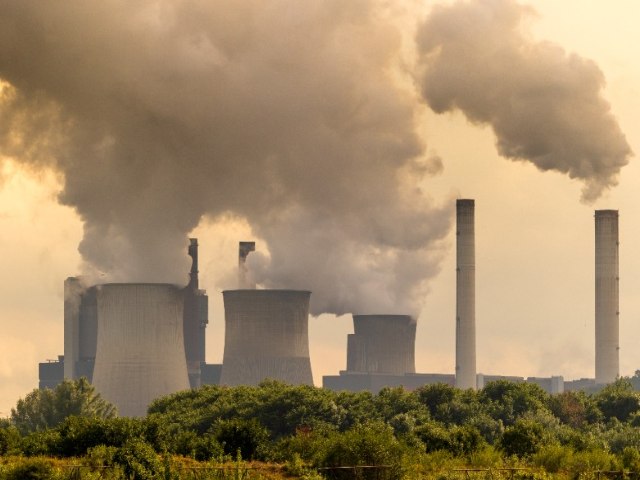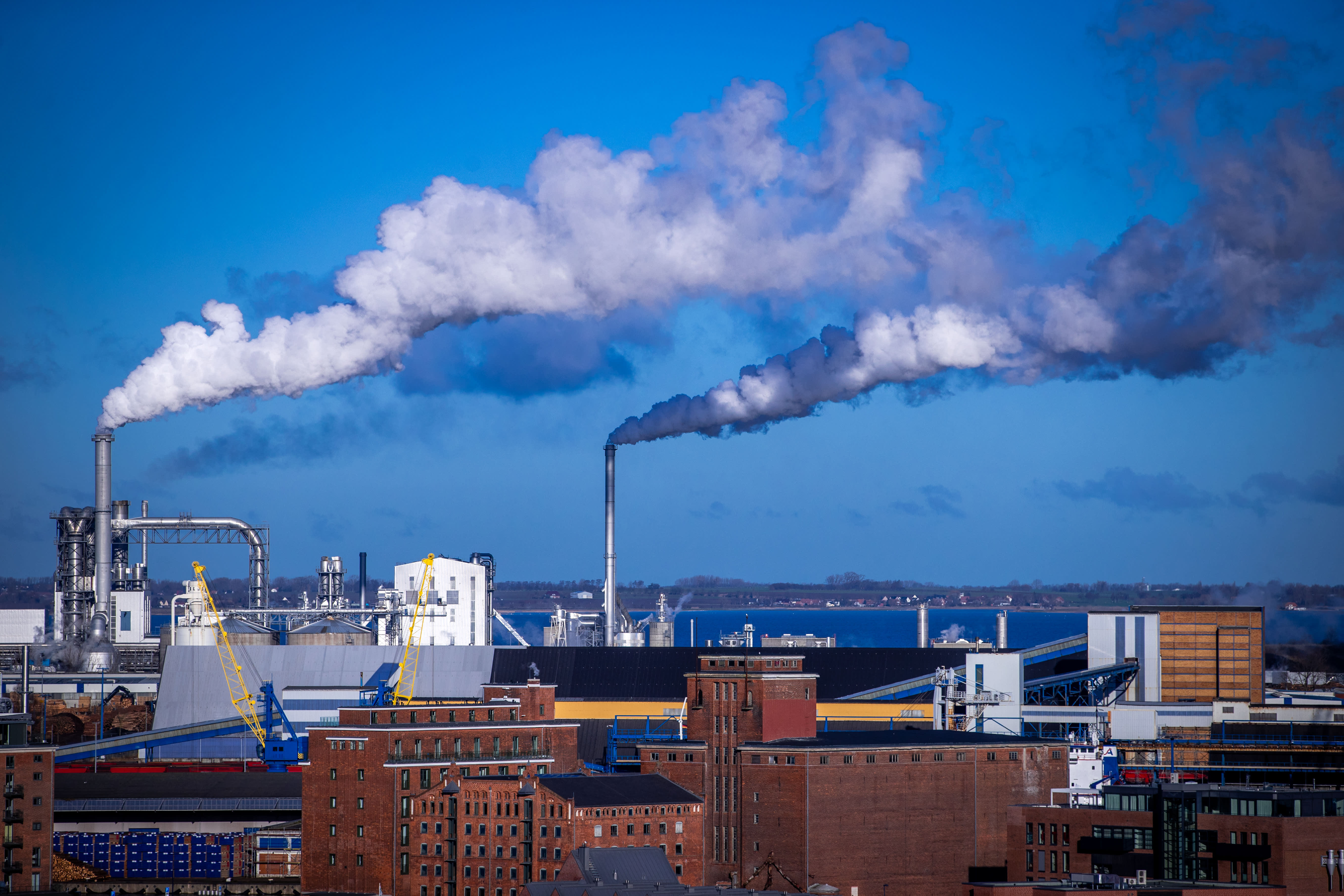
06 January 2022, Mecklenburg-Western Pomerania, Wismar: Smoke rises from chimneys of wood-processing industrial plants at the seaport of Wismar. Photo: Jens Büttner/dpa-Zentralbild/ZB (Photo by Jens Büttner/picture alliance via Getty Images)
Eric Toone is a technical lead investor for Bill Gates’ climate tech investment firm, Breakthrough Energy Ventures. He’s one of two people who has to sign off on any deal for it to get funded, and he has signed off on five investments in carbon capture technology, four of which have been publicly announced.
Carbon dioxide from burning fossil fuels is a primary source of human-caused climate change. Carbon capture is a set of methods — some time-tested, some experimental — for reducing carbon dioxide emissions either by removing them at the source or from the atmosphere. (The term “carbon” is often used as shorthand for carbon dioxide, CO2, in discussions about capture and sequestration technology.)
Toone understands the arguments against carbon capture technology, but he’s optimistic anyway.
One big fear is that carbon capture technology presents a “moral hazard,” he told CNBC in a video conversation. If carbon capture technology becomes cost effective, then companies might not decarbonize their operations — they’ll just continue emitting and then pulling the carbon they emitted out of the atmosphere, effectively treading water in the emissions race.
Instead, critics say, companies need to focus on decarbonizing their operations by using renewable energy and increasing energy efficiencies.
Toone thinks this is a false dichotomy.
“It needs to be all of the above,” Toone told CNBC.
That’s also what the most recent report from the United Nation’s Intergovernmental Panel on Climate Change says.
Carbon dioxide removal is “necessary” for “counterbalancing ‘hard-to-abate’ residual emissions” and it “is also an essential element 34 of scenarios that limit warming to 1.5°C or likely below 2°C by 2100,” the technical summary of the report says.
Who’s paying?
For a technology to scale, however, there has to be demand.
It’s easy to see the economic demand for lower-carbon alternatives to existing products. Wind and solar can be cheaper than fossil fuels for generating electricity, electric vehicles can eliminate expensive trips to the gas station, and improvements to industrial processes and building efficiency save not only energy but money.
So who is going to pay for carbon dioxide removal, and why?
“That’s the $64,000 question,” Toone told CNBC.
Right now, the carbon capture market is voluntary, meaning companies participate if they choose, not out of any enforced federal requirements or regulations. That market has seen some green shoots lately. For example, in mid-April, the online payments-technology provider Stripe teamed up with several other tech companies, including Google parent Alphabet and Facebook parent Meta, to commit nearly $1 billion to spur the carbon-capture market.
Stripe would like to see other companies grow the initial pool of funding, but also recognizes that the industry will almost certainly need government intervention. That could come in the form of a price on carbon, subsidizing carbon removal that private companies do, or funding research, Stripe’s Florian Maganza told CNBC.
But for now, the demand side is extremely uncertain. There is some demand from industry — the carbonated beverage industry, for example, pays up to $1,000 a ton for carbon dioxide in some markets, while the oil industry pays around $35 a ton for carbon dioxide to use in enhanced oil recovery, Toone explains. But by and large, the carbon capture market assumes that government regulation or incentives will increase over time as the problem of climate change becomes more obvious and managing it becomes a political necessity.
“Until society prices carbon — no, there’s no way to make money on carbon capture other than through voluntary markets,” Toone said. “It’s the Wild West.”
However, around 25 other countries do have some sort of carbon market.
“The largest – by far – is China,” Toone told CNBC.
“China’s system focuses first on the power sector and is based on emissions per unit of output. Individual producers will provide information on output of both power and emissions, and then receive a credit based on historical output and then either pay or receive credit depending on whether they are over or under their allowance.”
The chemical method: Hard and expensive
Uncertain demand is not the only challenge. Carbon capture at scale is also technically challenging and expensive to pull off.
Broadly speaking, there are two main components to carbon capture technology. First, there’s the capturing — it has to be pulled out from the air. Then, there’s the sequestration piece — once you have the carbon captured, you need to put it somewhere.
Direct carbon capture can reduce carbon emissions at the point where they’re being produced, but it’s hard to scale because each plant has to be retrofitted on a custom basis. Moreover, it does nothing to remove the carbon dioxide that’s already been emitted from other sources over the last 150 years.
To remove carbon that’s already in the atmosphere, you need to rely on photosynthesis from plants —planting trees, for instance — or on chemical technology.
With chemical carbon capture, air has to pass by a technical apparatus so the carbon dioxide can bind to whatever chemical is being used. Pumping enough air through that technical apparatus requires a lot of energy.
“When carbon dioxide is present at only 400 parts per million in air, it means I have to pass an absolutely enormous amount of air over those structures to capture it,” said Toone.
To capture one million tons, or one megaton, of carbon dioxide in a year, an operation would need to move 46,000 cubic meters of air per second — and that’s assuming it captures 100% of the carbon dioxide in the air, Toone told CNBC, according to his own calculations. More realistically, you’d capture only half the carbon dioxide, meaning you’d need to move more than 100,000 cubic meters of air per second.
And that’s just for a single megaton.
The U.S. government has a goal to remove multiple gigatons, or one billion metric tons, of carbon dioxide from the atmosphere by 2050 and store it “durably” for less than $100 per ton. The Department of Energy calls this goal its Carbon Negative Earthshot.
For the carbon capture project to be successful, the amount of carbon emissions created to make the energy to operate the carbon capture machinery must be less than the carbon dioxide captured by the contraption — otherwise the whole effort is null and void.
“Yeah, the numbers start getting pretty scary,” Toone said.
Two companies leading the charge, according to Toone, are Carbon Engineering and Climeworks. (Breakthrough is not an investor in either.)
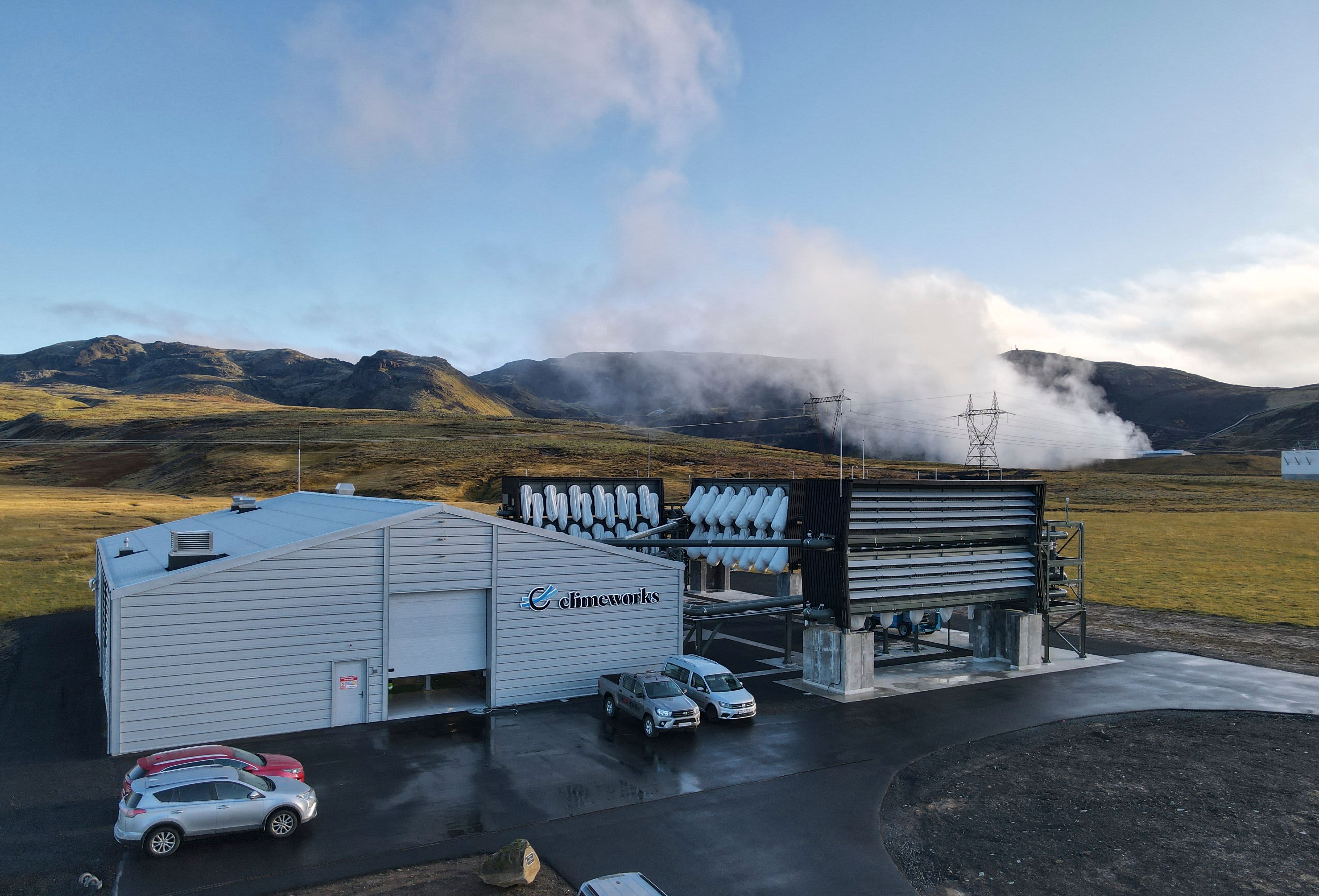 Climeworks factory with it’s fans in front of the collector, drawing in ambient air and release it, as largely purified CO2 through ventilators at the back is seen at the Hellisheidi power plant near Reykjavik on October 11, 2021. - Climeworks factory is in ICELAND containers similar to those used in maritime transport are stacked up in pairs, 10 metres (33 feet) high. Fans in front of the collector draw in ambient air and release it, largely purified of CO2, through ventilators at the back. (Photo by Halldor KOLBEINS / AFP) (Photo by HALLDOR KOLBEINS/AFP via Getty Images)
Currently, Climeworks is able to capture carbon dioxide at a cost of approximately $600 to $800 a ton, Judith Hebekeuser, communications manager at Climeworks told CNBC. That cost should fall to between $250 to $300 per ton by 2030 if Climeworks is operating at the scale of millions of tons. And if the industry matures as expected, then costs should come down to $100 to $200 per ton.
Toone says the U.S. government’s goal of $100 a ton is not unreasonable.
“The cost of solar since 1975 has fallen 300-fold,” Toone noted. “It absolutely passes the giggle test,” Toone said.
Once carbon is removed from the atmosphere, there are two basic ways to store it: Biologic and geologic. Biologic carbon sequestration is when carbon from the atmosphere is stored in plants, the soil, wood or even the ocean. Geologic carbon sequestration is the process of storing carbon dioxide underground. To do this, companies either pump the carbon dioxide into underground caverns, or combine it with a liquid and pump it into porous rock formations where the CO2 can “mineralize” over time.
At its first commercial carbon removal plant in Iceland, Climeworks takes the carbon dioxide it removes from the air and gives it to a partner company, Carbfix, which takes the carbon and injects it into water underground to react with basaltic rock. Over the next two years, the carbon turns to solid rock, “locking it away for hundreds of thousands of years,” Hebekeuser told CNBC. While permanent storage is Climeworks’ primary focus, it’s open to other options, like carbon upcycled products or to make renewable fuels.
The verification question
There are other, mostly non-chemical methods that “cost a tiny, tiny, tiny fraction of that $100 per ton,” Toone said, but verification is a big problem for many of them.
Growing trees is one example. But trees die, they get burned down by forest fires, they get cut down for lumber.
Companies like Pachama, a part of Breakthrough’s investment portfolio, are working to verify how much carbon is captured in an acre of forest.
Another example is using naturally occurring chemical calcium silicate, putting it on the beach and leaving it there. Calcium silicate reacts with carbon dioxide in the ocean water to make calcium carbonate, which is an insoluble solid that sinks to the bottom of the ocean. The ocean will continue to pull more carbon dioxide out of the air in order to stay in equilibrium, according to Toone, who was a chemistry professor at Duke University for almost three decades before joining Breakthrough.
But without verification, these methods won’t take off.
“We live in absurdly cynical times,” Toone told CNBC. If there’s a sense that carbon capture is a scam, then people are not going to pay for carbon to be captured at all. “We’ve got to bring society along with this. And so I think the validation and the verification are extremely important.”