“But what happens when the sun goes down?” This age-old refrain now has a definitive answer: “Batteries take over.”
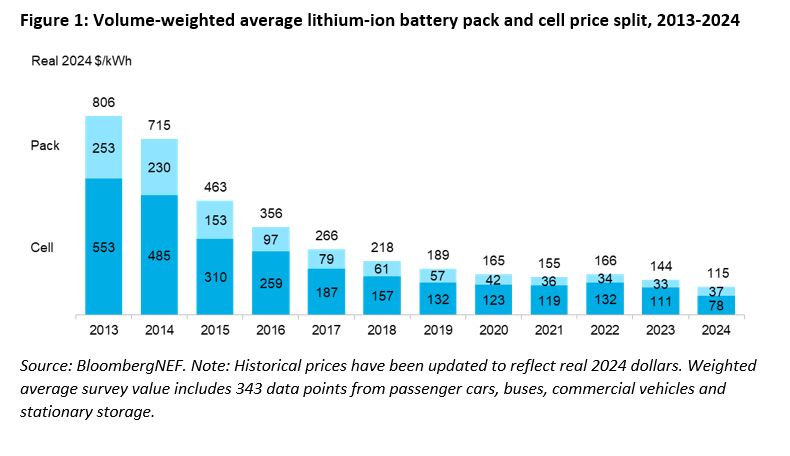
Throughout 2023 and 2024, lithium-based batteries have evolved from being merely useful, and somewhat expensive, to being on the brink of affordability and widespread deployment. This transformation has been driven by substantial reductions in cost and increases in manufacturing and deployment volumes.
But before we dive into those details, let’s first discuss why batteries are such a useful technology.
Batteries are fast
Imagine batteries as spacecraft or missiles, adjusting their trajectory with precise, quick bursts of energy. In astronautics, this is known as a “reaction control system,” an essential technology since the days of the first Apollo missions. Similarly, batteries are capable of delivering precise amounts of energy within milliseconds. This capability proved crucial when the world’s first large-scale battery installation prevented a blackout in Australia by responding more rapidly than traditional power plants could.
With their microsecond response times, batteries provide ultra-precise energy outputs that are critical in moments of sudden demand. This rapid response allows batteries to act more quickly than the slower, more cumbersome responses of traditional fossil-fueled plants. Recognizing the advantages of this rapid response, Australia was able to significantly shorten the required reaction time for power plants from 30 minutes to just 5 minutes.
Combined with grid-forming inverters, batteries are helping the power grid wean itself off the physical spinning masses that have traditionally provided stability during complex grid events.
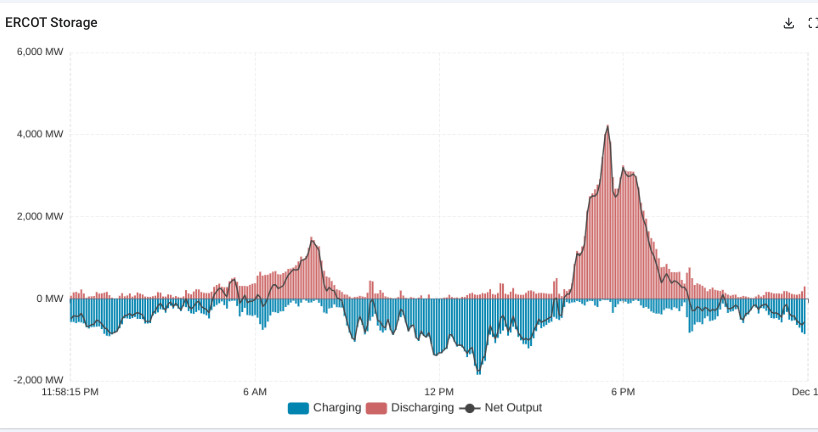
The microsecond reaction time not only enhances grid stability but also enables battery developers to maximize revenue when power prices spike. The graph below from GridStatus.io illustrates how batteries in Texas capitalize on their nimble reaction times by charging during lower-priced, solar-powered periods and discharging during peak price times, effectively stabilizing energy costs.
Source: GridStatus.io
Batteries are distributed
Large and small battery installations alike are making headlines. In 2018, Vermont used a mix of residential and grid-scale batteries to save ratepayers on utility-level demand charges, achieving a savings of $6.7 million on one warm summertime Tuesday. The following year, Sunrun earned the trust of the New England System Operator by integrating 5,000 residential solar and storage installations, marking some of the first virtual power plants in the United States.
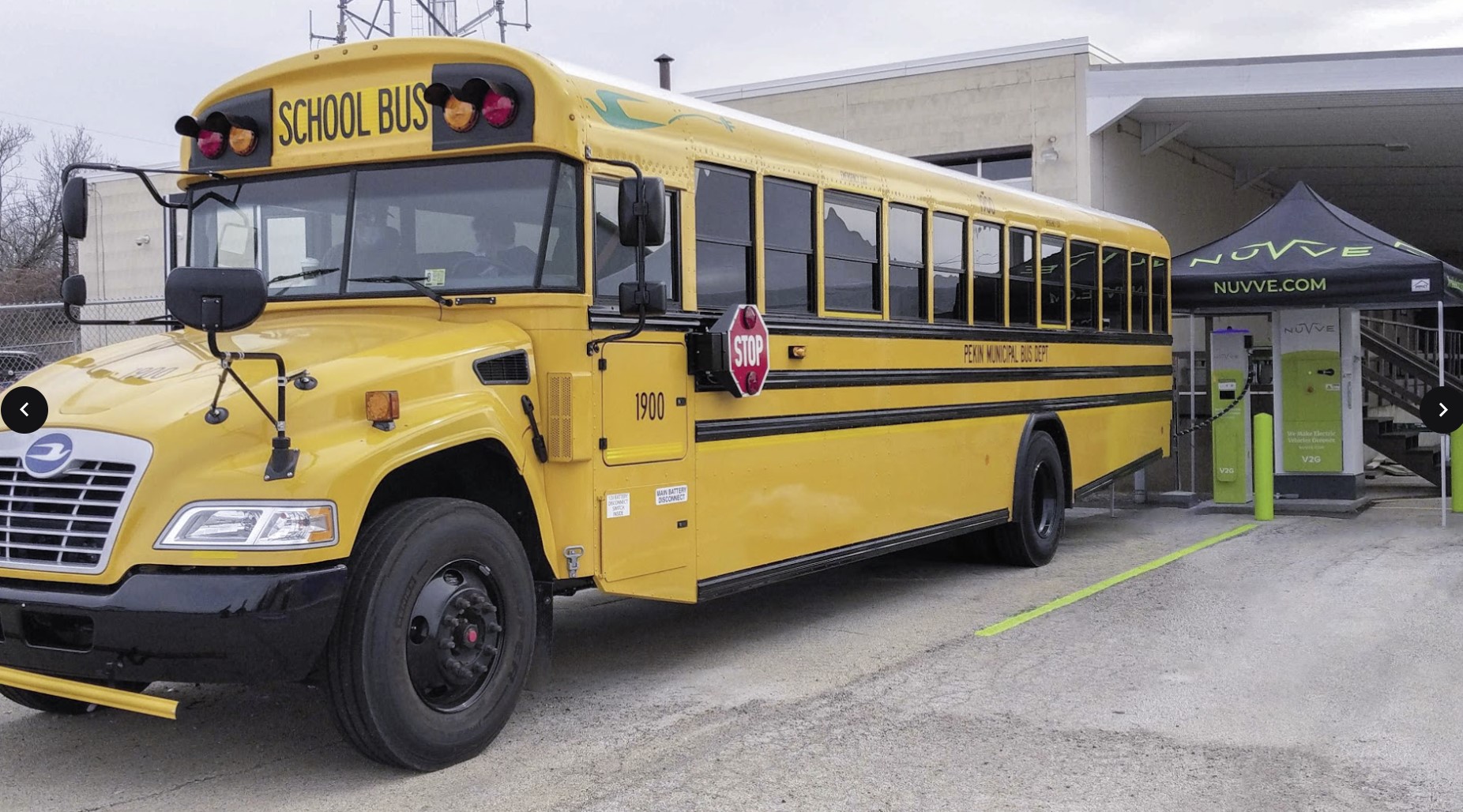
Image: Nuvve, vehicle-to-grid connected electric school bus
Imagine if 300 million electric vehicles (EVs) in the U.S., including cars, buses, trucks, and fleet vehicles, were all connected to the grid. Each with an average battery size of 75 kWh, they would collectively offer about 22.5 TWh of capacity, enough to power the country for two days. Because vehicles tend to follow human beings, they’re generally positioned strategically to deliver electricity precisely where it’s needed.
Perhaps, in the not-too-distant future, it will become a social faux pas not to plug in your vehicle, much like recycling or turning off the lights when you leave a room.
Extending this concept, consider every residential, commercial and industrial building, along with electric substations, all equipped with substantial batteries. Together, they would form a vast network, contributing to a balanced power grid. This network would seamlessly integrate mobile and stationary storage solutions to meet demand across diverse locations, ensuring a reliable and responsive energy system.
Batteries generate creativity
What if, instead of relying solely on battery backups for our homes, we expanded the concept to include all types of home electronics? Single purpose designed battery backups for consumer lightbulbs are becoming a thing, especially in EXIT signs that are legally required to pair LED lighting with lithium batteries.
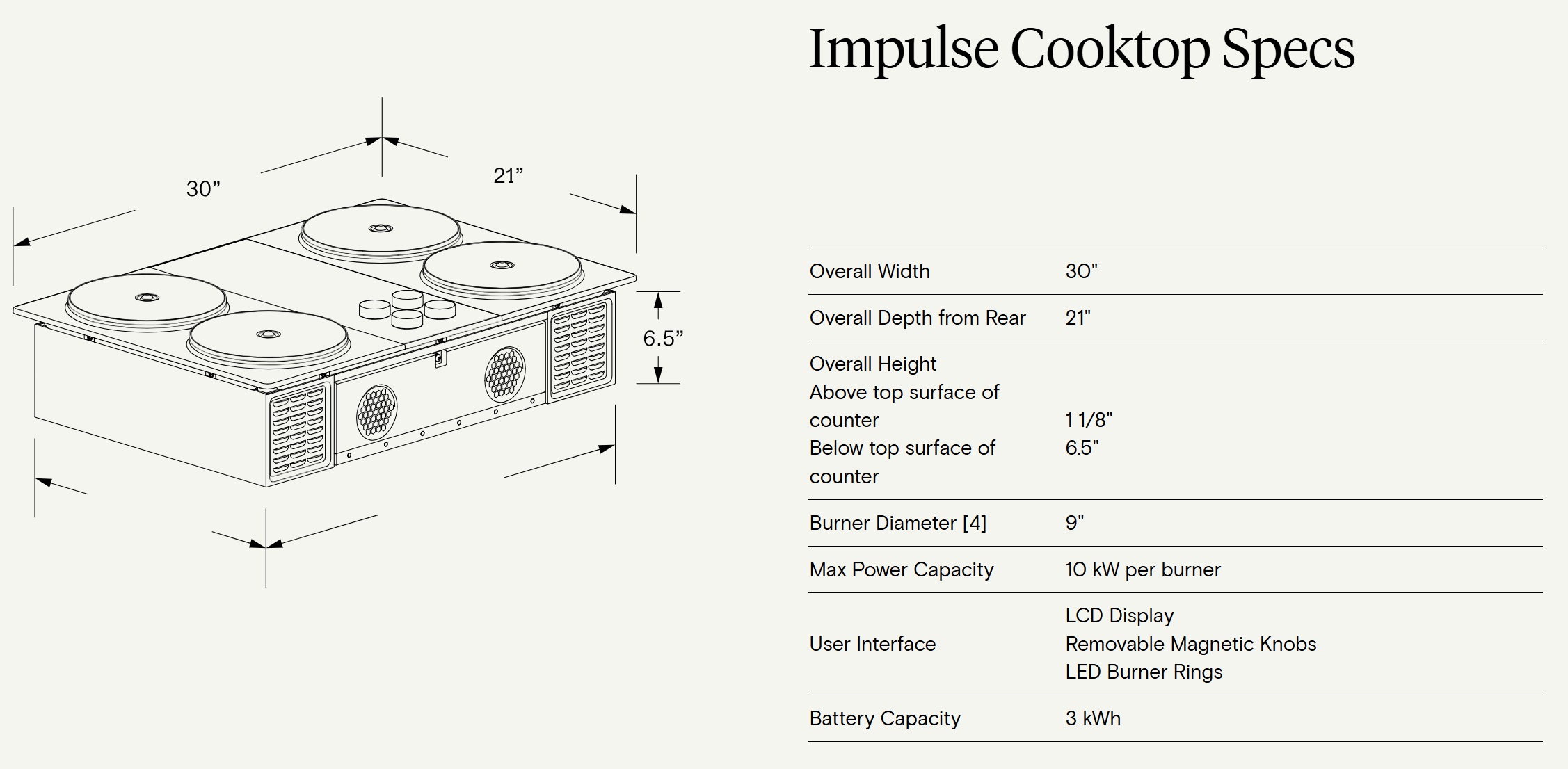
Consider the potential of “smart” appliances; not merely capable of internet connectivity but those designed to provide electricity to your home during peak demand. An induction stovetop or a heat pump does pull significant electricity that can strain outdated wiring. To mitigate the required upgrades, Impulse Labs has integrated a 3 kWh battery into its induction stovetops.
Integrating batteries into commercial buildings and high-demand appliances effectively ‘shaves the peak’—the peak being the maximum energy an appliance draws at any given time. This approach was one of the first financially viable uses for distributed batteries on the grid, helping to offset costly peak demand charges. Energy utilities invest heavily in backup power plants to manage these peaks, ensuring there is sufficient supply when collective demand spikes.
Similar needs drive the integration of batteries into EV chargers, which often demand substantial peak power. One recent innovation saw an EV truck stop incorporating batteries to reduce the strain on the grid, enabling faster, more economical grid connections.
Imagine a landscape populated with big batteries, small batteries, EVs, stoves, light bulbs, and countless other devices—all providing energy exactly when needed and recharging when it’s most economical.
Batteries are scaling & getting cheaper
Much like the solar industry, the battery sector has experienced significant price declines, particularly after the supply chain challenges caused by the COVID pandemic. These declines were recently punctuated by bids for fully installed battery systems in China dropping to as low as $60/kWh.
A bid price this low is now pushing the boundaries of what was once considered possible, prompting us to contemplate the future of battery costs and capabilities. For instance, how low could the price of lithium-ion batteries drop? And what will energy storage adoption look like as prices drop to increasingly smaller fractions of their currentt value?
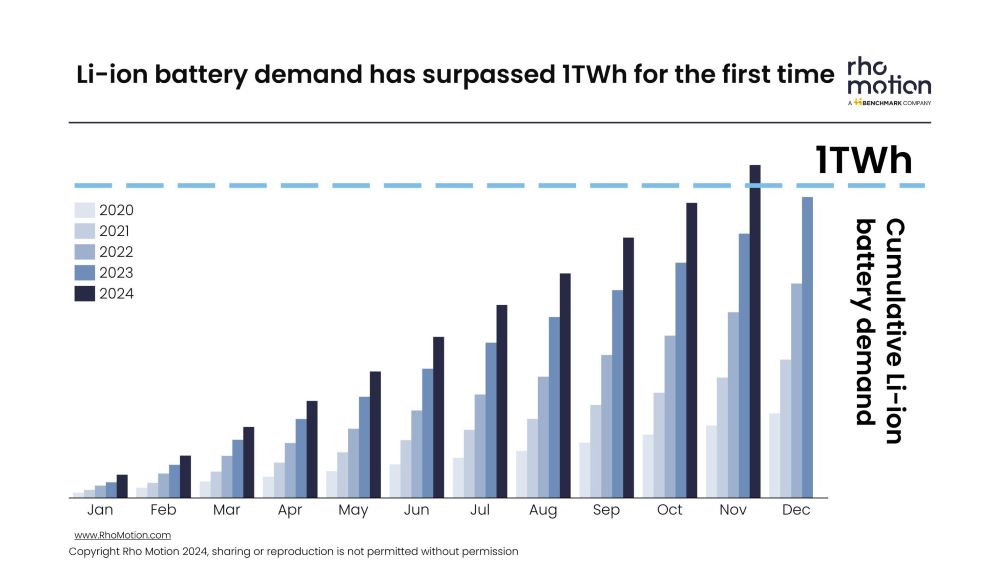
In 2024, we anticipate deploying more than 1 TWh of energy storage globally for the first time. Driven by robust EV sales and extensive BESS deployments, the demand for lithium-ion batteries continues to soar, suggesting the potential for five more capacity doublings in the near future.
Although current estimates indicate that we’ve deployed less than 5 TWh of capacity globally, the urgent need to transition transportation and energy systems away from fossil fuels may require several hundred TWh. Since battery cell costs fall by 20% to 30% with each capacity doubling, prices could potentially drop to as low as $10 to $20 per kWh.
When pv magazine USA consulted esteemed energy modeler Dr. Jesse Jenkins regarding the competitiveness of lithium-ion prices against baseload energy sources defined for their constant output, he clarified:
No price provides baseload, as that requires continuous discharge. If you mean what price permits multi-day storage that allows wind+solar to displace firm capacity, then $1-10/kWh is what we found here. $20-30/kWh would eat into it.
Our ‘pale blue dot’ is often likened to a spaceship, exploring the vastness of the galaxy. Aboard this vessel, eight billion crew members diligently manage a vast network of distributed transmission and storage. Let’s envision a ship where batteries of all sizes, from those powering nightlights to those powering containerships, all operate together as a vast orchestra of energy as we hurtle through the cosmos.
The uncharted potential of energy storage
While it’s conceivable that solar, wind, and energy storage might alone suffice to meet all of humanity’s energy demands globally, we don’t need to do that. However, technologies like lithium-ion and sodium batteries offer rapid, scalable storage solutions that can complement the capabilities of long-duration storage systems, such as those developed by Form Energy. Together with existing energy sources like nuclear, hydro, and anticipated advances in geothermal technology, there is a clear path towards cleaning our electricity and energy systems.
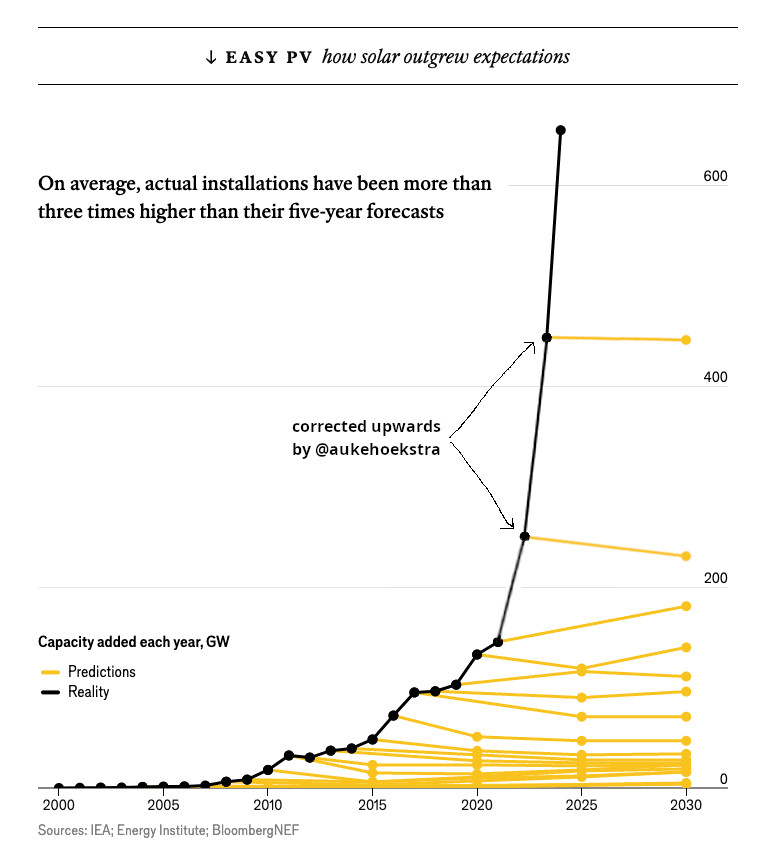
However, the future of energy storage, like all technology, comes with its uncertainties. We don’t know the final forms these batteries will take, their eventual cost, their longevity, or the pace at which they will be deployed.
Our ability to predict technological advancements and deployment scales is notably imperfect, as demonstrated by the historical underestimates of solar capacity expansions. The chart above, initially created by Auke Hoekstra, (founder and director of the NEON research program), highlights the International Energy Association’s consistent underestimation of the solar revolution since the early 2000s. This serves as a stark reminder of our forecasting limitations; as recently as 2022, the deployment of over 400 GW of solar capacity far exceeded analysts’ predictions, and we are now anticipating our first terawatt year, with expectations of reaching 600 GW of global solar capacity by 2024.
Despite these challenges, there is a substantial cause for optimism in the realm of energy storage. This sector promises to be a dynamic and potent complement to the already robust expansion seen in solar power, creating a powerful technological feedback loop.