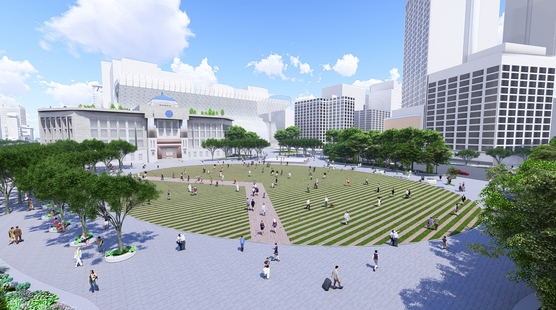
A render of how Seoul Plaza will be renovated under the city government's new plan.
Previously an event-focused venue hosting over 300 festivals and exhibitions annually, Seoul Plaza will now feature a garden-like atmosphere. The renovation includes planting 24 pine trees, six zelkova trees, and various flowers and shrubs. Approximately 300 movable planters with mountain maples and rowan trees have been placed around the plaza, and a garden-style photo zone with Seoul City Hall as a backdrop has been created for visitors.
To enhance environmental sustainability, the plaza’s grass, frequently damaged by events, has been replaced with durable Korean turf suited to Seoul’s climate. Wooden pathways connect grass areas, and an upgraded drainage system addresses issues caused by 21 years of soil compaction. The government noted: “We have addressed the previous limitations of lacking shade and resting spaces.” The renovation is projected to reduce carbon emissions by approximately 331.92 tons annually.
The transformation is ongoing, with additional enhancements planned for November, including six zelkova planters with seating on the plaza’s east side and sitting walls around the garden. The Seoul Plaza Forest and Garden project is expected to be fully completed by April 2026. Lee Soo-yeon, head of the Seoul Metropolitan Government’s Garden City Bureau, said: “We will transform Seoul Plaza, a landmark of Seoul, into a relaxing space where citizens can enjoy culture and art and stay for long periods.”
In a separate initiative, the Seoul Metropolitan Government and the Seoul Archdiocese of the Catholic Church planted 300 Cornus officinalis trees on the southern slope of Sky Park in World Cup Park, Mapo District, on Saturday. The two entities plan to sign an agreement in September to develop an ecological scenic forest in the same park. Under this agreement, the Archdiocese will plant trees across 2,000 square meters of a 52,000-square-meter vacant area, with Seoul providing the site, planting education, and maintenance support.
These efforts reflect Seoul’s commitment to enhancing green spaces and promoting sustainable urban environments, creating inviting areas for residents and visitors alike.