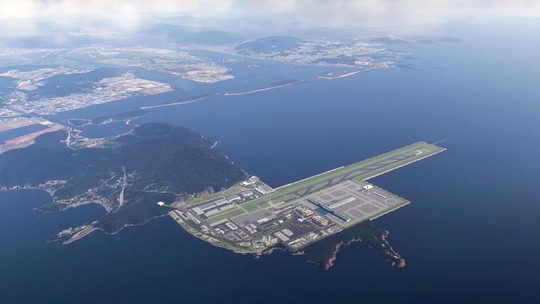
A render of the layout of Gadeokdo New Airport
On Friday, Hyundai E&C stated: “Despite efforts to ensure safety and quality, it has become impossible to secure a timeline that guarantees safety. We have therefore decided not to participate in the land reclamation project for the Gadeokdo New Airport.” The company emphasized that this decision was made independently, not reflecting the position of the consortium it was part of.
The Ministry of Land, Infrastructure and Transport had previously terminated the private contract with the Hyundai E&C-led consortium for the land reclamation work after the company requested an additional 24 months beyond the original schedule, a request that was denied. This led to criticism from local governments and civic groups.
Hyundai E&C responded: “To minimize project delays and support the success of this national project, we will relinquish our rights related to the basic design and actively cooperate in selecting a new contractor.” The company also clarified: “By relinquishing all rights related to the consortium, we aim to allow the consortium to continue participating in the project and thereby minimize delays.”
Addressing concerns, Hyundai E&C stated: “It is unacceptable to accept reckless demands and conditions to shorten the construction timeline that compromise airport safety due to local and political interests. We also reject the unfair accusation that we are delaying a national project or causing additional taxpayer spending for personal gain.” The company further noted: “Even though our proposal was aimed at correcting fundamental flaws in the master plan that fail to guarantee public safety, we are now facing criticism for allegedly using this as a trick to demand additional costs, receiving undue privileges and avoiding social responsibility.”
The project involves significant engineering challenges, including moving earth equivalent to nearly three times the size of Mount Namsan in Seoul and reclaiming an area 2.3 times the size of Yeouido. Hyundai E&C described it as “Korea’s most difficult construction project,” adding: “We believe securing a reasonable construction period is a nonnegotiable prerequisite to ensure safety and quality.”
The company emphasized its commitment, stating: “During the basic design process, we mobilized around 250 experts and invested 60 billion won ($43.5 million), conducting an in-depth six-month technical review.” They also analyzed projects like Japan’s Kansai International Airport, Hong Kong’s Chek Lap Kok International Airport, and the recent Muan Airport incident to determine a safe construction timeline.
Hyundai E&C concluded: “This was a responsible decision made with the safety of future airport users and the success of this national project as our top priorities.”