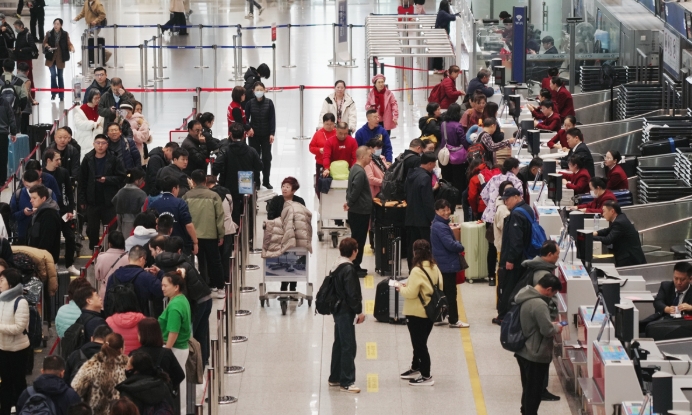
Passengers queue for check-in at the Beijing Capital International Airport on January 14, 2025.
Passenger travel from China surged, with a 241% increase to Africa, 233% to Central Asia, and 91% to West Asia. Currently, 28 Chinese airlines and 100 foreign airlines operate routes to 78 countries, four more than in 2019. Weekly international flights averaged 6,395, reaching 83.9% of 2019 levels, with 6,960 flights during the Spring Festival peak, or 91.3% of 2019, according to the CAAC.
Luo Chengtao, chief analyst at VariFlight, told : “The data show a rapid recovery and structural optimization of the international aviation market in China.” The industry has evolved from recovery to structural improvement, driven by strong demand. Lin Zhijie, an independent analyst, noted: “There has been a fast recovery of Chinese airlines in the global network, which shows the resilience of the industry.”
Air China, the national flag carrier, announced on Thursday plans to launch direct flights from Beijing to Cairo, Egypt, and Toronto, Canada, and routes to Vladivostok and Irkutsk, Russia. It will also introduce services from Seoul and Hong Kong via Beijing Daxing International Airport, resume flights from Chengdu to Tokyo and Paris, and open routes from Beijing and Urumqi to Tashkent, and Beijing to Almaty. Air China stated: “In addition, Air China will open routes from Beijing to Tashkent, from Urumqi to Tashkent, and from Beijing to Almaty and other Central Asian routes.”
Flights to 35 countries, including Japan, the UK, and Italy, have exceeded 2019 levels, with 94.5% of 2019 flight volumes restored for Belt and Road Initiative countries. Enhanced connectivity spans Asia, Europe, Latin America, the South Pacific, and Africa. Chinese Vice Commerce Minister Sheng Qiuping reported: “In the first quarter of this year, the number of inbound foreign tourist trips reached 9.215 million, a year-on-year increase of 40.2 percent.”
The CAAC is promoting expanded routes in emerging markets, strengthening China’s global aviation network. This growth supports increased international travel and economic integration, reflecting the aviation sector’s adaptability and focus on meeting global demand.