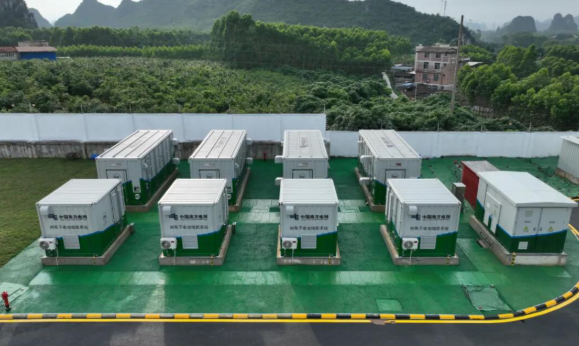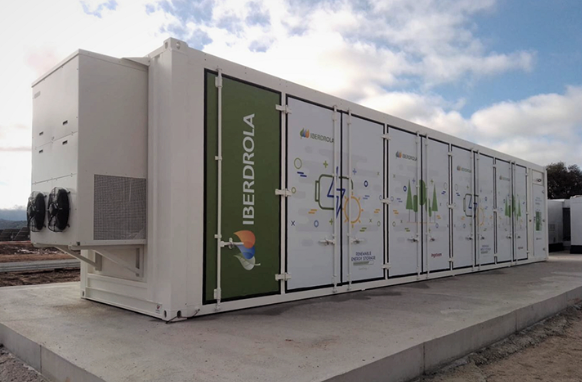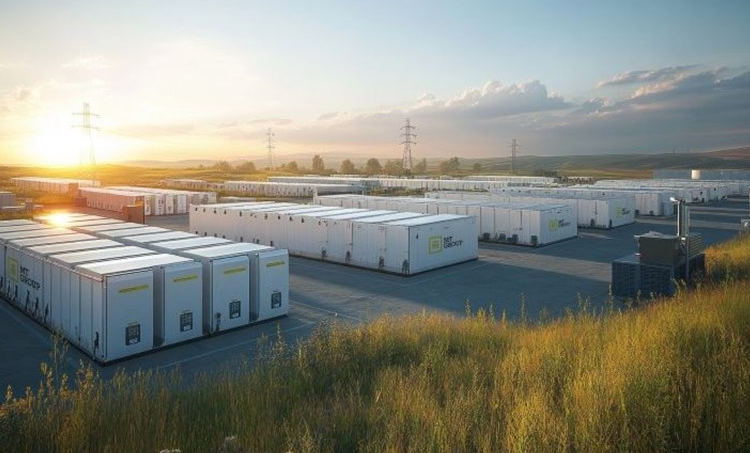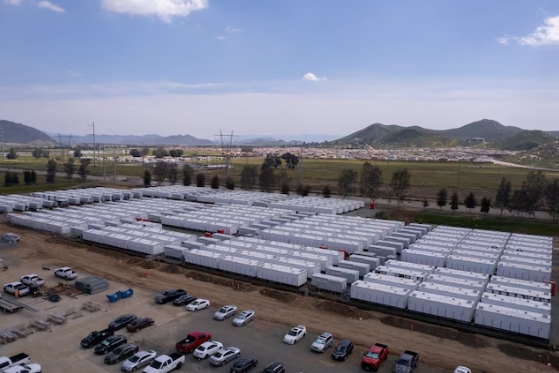
A drone view shows California's largest battery storage facility, as it nears completion on a 43-acre site in Menifee, California, U.S., March 28, 2024.
Batteries stabilize grids by regulating frequency and voltage and preventing overloads, storing excess solar power for release during high demand. By April 2025, U.S. battery capacity neared 30,000 megawatts (MW), a sharp rise from 2020, when solar and wind capacities were 30 and 74 times greater, respectively, per Cleanview.
Since 2022, battery costs have declined by up to 40% annually, driving adoption in solar-heavy regions. By April 2025, solar and wind capacity was only five times greater than battery capacity. Batteries store midday solar surplus, when prices and demand are low, for discharge during peak periods, optimizing prices and grid efficiency.
Nineteen states have at least 100 MW of battery storage. California, with 13,000 MW (42% of the U.S. total), integrates 12,400 MW of battery capacity with 21,000 MW of solar, per the California Energy Commission. On June 19, from 7 p.m. to 9 p.m., batteries provided 26% of CAISO’s power, surpassing natural gas (23%), wind, and hydro, per GridStatus.io.
Texas added significant battery capacity in 2024, reaching 8,200 MW by April 2025, contributing 7–8% of ERCOT’s evening power on June 19. Arizona, Nevada, and New Mexico are also expanding battery systems alongside solar growth.
With battery costs projected to fall further, they rival natural gas ($47–$170/MWh) and coal (up to $114/MWh), with solar-plus-battery systems at $50–$131/MWh, per Lazard. Faster deployment than new plants supports battery expansion into diverse regions.