Gyrotrons, often called “plasma starters” or “wave generators,” are critical components for auxiliary heating in ITER. They generate high-frequency waves at 170 GHz, matching the resonant frequency of electrons in the plasma. This electron cyclotron resonance heating (ECRH) transfers energy from electrons to ions by collision, enabling the plasma to reach the necessary conditions for fusion.
ITER’s original baseline design called for 24 gyrotron devices, with contributions from several partners: 8 from Japan, 8 from Russia, 6 from Europe, and 2 from India. The first sixteen, produced in Japan and Russia, have successfully passed factory acceptance testing and been delivered to ITER. These units are being installed one by one on the “gyrotron floor” of the Radiofrequency Building.
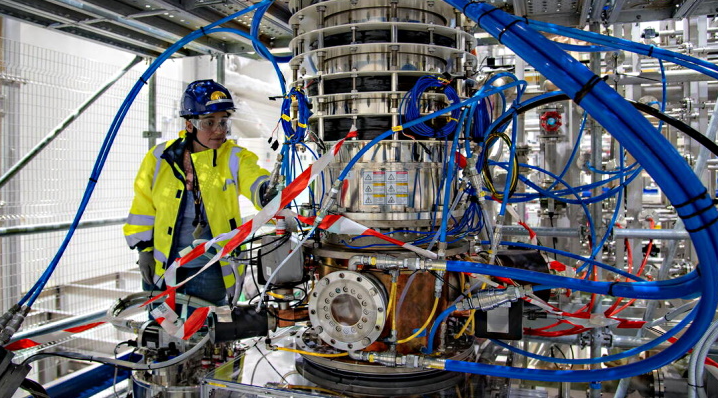
The first 2.7-metre-tall gyrotron, procured by the Japanese Domestic Agency, has now been installed and connected to its power supply. Commissioning will begin later this month, with one of the highlights expected to be the generation of the first radiofrequency waves, according to the ITER Organisation.
ITER is designed as a tokamak fusion device to demonstrate the feasibility of fusion as a large-scale, carbon-free energy source. Its goal is to operate at 500 MW for at least 400 seconds continuously, powered by 50 MW of plasma heating input, though additional external electricity will be required for operation. ITER itself will not generate electricity but aims to prove the scientific and technical principles necessary for future reactors.
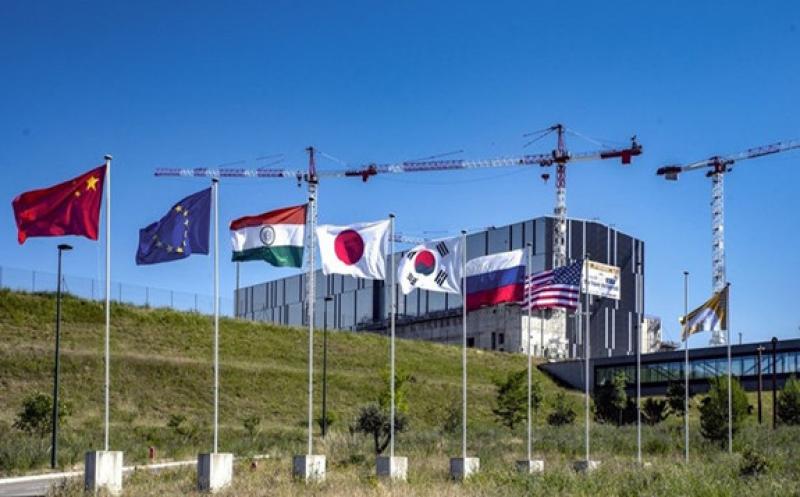
The project involves 35 nations. The European Union contributes nearly half of the construction costs, while China, India, Japan, South Korea, Russia, and the United States provide equal shares of the remaining expenses. Construction began in 2010, with the first plasma originally scheduled for 2018 but later delayed to 2025. A revised plan announced in June 2023 now targets deuterium-deuterium fusion operations in 2035, followed by full plasma current and magnetic energy operation.
The updated baseline requires more powerful plasma heating. Plans now call for 48 gyrotrons at the start of ITER operations, with another 24 required for the first deuterium-tritium plasma phase (DT-1). This has led to expanded procurement and the construction of additional facilities for both gyrotron and ion cyclotron resonance heating systems.
General Atomics has completed the central solenoid, described as the world’s most powerful pulsed superconducting magnet. The system consists of six modules, each weighing more than 122.5 tonnes, fabricated over 15 years at the company’s Magnet Technologies Center in Poway, California. When stacked, the modules will form a structure more than 18 metres tall, 4.25 metres wide, and over 1,000 tonnes in weight.
“This project signified a watershed moment for the US and for General Atomics,” said Wayne Solomon, vice president of Magnetic Fusion Energy for the General Atomics Energy Group. “As the first private company to take on the challenge of building fusion magnets at this scale, GA is proud to be leading the way in developing the technologies needed to make fusion power a reality.”