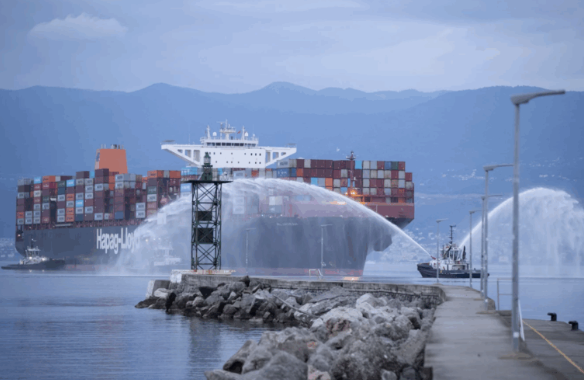
During the event, Croatian Deputy Prime Minister and Minister of the Sea, Transport and Infrastructure, Oleg Butkovi?, described the opening as a “historic moment” for Rijeka, Primorje-Gorski Kotar County, and Croatia as a whole. He noted that the process leading to the terminal’s launch required substantial effort, from financing and road construction to finalizing the concession agreement.
Denis Vukorepa, Director of the Port of Rijeka Authority, emphasized: “We now have the first vessel berthed at a new, sustainable, ‘green,’ and technologically most advanced container terminal in this part of Europe. When we signed the concession agreement with Rijeka Gateway in November 2021, I said it was the largest agreement in the history of the Port of Rijeka, the most significant in importance and value, for this city, for the Port Authority, for the port, the transport corridor, and the entire Croatian port and transport system.”
According to Vukorepa, total investments in the Rijeka Gateway and related infrastructure amount to around €600 million (about $701 million). This includes the 400-meter quay financed by a World Bank loan, the DC 403 access road, internal port roads, the intermodal terminal, rail links, and €380 million invested by the concessionaire in equipment and hinterland facilities. The equipment covers STS cranes, storage and gantry cranes, and other installations designed to ensure efficient operations.
Tomislav Rosandi?, CFO of Rijeka Gateway, underlined the importance of rail links: “Reliable rail connectivity is extremely important for our terminal, so we strongly support the construction of the lowland railway that will enable Rijeka to become the entry point for Central and Southeastern Europe. Currently, our plan is to handle 60% of terminal-related traffic by rail, and we look forward to the potential to increase this share further, as it will strengthen both the competitiveness and sustainability of the terminal.”
The Rijeka Gateway is also integrated into the Gemini Cooperation between Maersk and Hapag-Lloyd, specifically within the EA12 service. Construction of the terminal began in September 2023, with the initial phase delivering a 400-meter-long, 20-meter-deep quay and an annual capacity of 650,000 TEUs. Future expansion aims to extend the quay to 680 meters and boost capacity to over one million TEUs.
In October 2024, the terminal secured electricity from renewable sources through ENNA Next, which issues green certificates to ensure the supply is primarily from solar and wind power. Ahead of full operations, the terminal welcomed the M/V Cape Fulmar in mid-August 2025, further preparing for today’s launch.