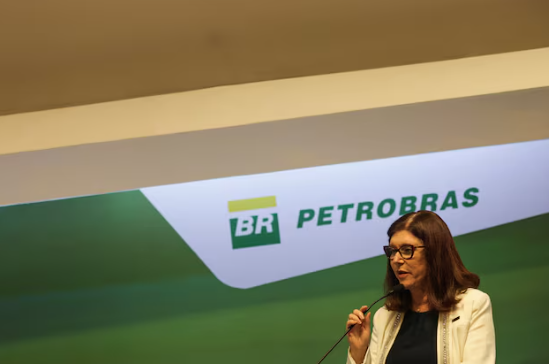
Brazilian state-run oil firm Petrobras CEO Magda Chambriard and the company's board attend a press conference in Rio de Janeiro, Brazil November 22, 2024.
According to Petrobras’ strategic plan, the company’s facilities in Bahia and Sergipe, both located in northeastern Brazil, will contribute 5% and 7% respectively to the country’s total urea supply. Meanwhile, the company’s unit in Paraná state, in southern Brazil, has already resumed operations and is expected to provide 8% of the national urea demand. All three plants had been inactive for several years before the restart.
Speaking at an event in Bahia state, Chambriard also noted that Petrobras is working to complete and reopen a nitrogen fertilizer plant in Mato Grosso do Sul state. This facility, once operational, is projected to meet around 15% of Brazil’s total nitrogen fertilizer requirements. “This plant is already being contracted, the construction will be completed, and once it's ready, we will be capable of delivering 35% of all the nitrogen fertilizer Brazil needs,” she said.
Chambriard added that the renewed investment in fertilizer production is in line with the goals of President Luiz Inácio Lula da Silva, who has encouraged Petrobras to increase its participation in the sector. Brazil currently relies heavily on imported fertilizers, particularly for its large agricultural industry. Strengthening domestic capacity has become a strategic priority for the government to ensure supply security and reduce exposure to external market fluctuations.
“With the public policies issued by the federal government and with our shareholders, we are aware of Petrobras’ strategic role,” Chambriard stated, emphasizing that the company’s revival of fertilizer operations supports national industrial policy objectives.
The resumption of fertilizer production also reflects Petrobras’ broader strategy to diversify its operations and enhance value creation across its industrial portfolio. The company plans to balance its investments in energy and downstream sectors with renewed efforts to support Brazil’s agricultural supply chain.
In a separate development, Danish renewable energy company Ørsted announced plans to reduce about 2,000 jobs worldwide by the end of 2027. The firm said it will refocus its operations on Europe after facing recent challenges in international offshore wind markets.