At the 20th HortiActive event held on September 24, the Head of BRIN’s Horticulture Research Center, Dwinita Wikan Utami, highlighted the benefits of this technological integration: “The combination of biotechnology and digitalization not only reduces production costs, but also increases sustainable agricultural productivity.” According to BRIN, this eco-friendly biofertilizer improves soil fertility and mitigates the environmental impact of chemical fertilizers.
Associate Researcher Erny Yuniarti from BRIN’s Horticulture Research Center presented findings on biostimulants derived from seaweed extracts combined with rhizosphere microbes to enhance shallot cultivation. Her study tested the use of seaweed extract with Bacillus subtilis bacteria on the Bima Brebes shallot variety, demonstrating that applying a 5 ml/liter dose of the biostimulant alongside 75% of the standard inorganic fertilizer achieved optimal vegetative growth. However, she noted that increasing the dry bulb weight still requires adjustments to potassium levels.
The research also identified optimal storage conditions for maintaining the effectiveness of biostimulants. Storing them at a low temperature of 19°C in opaque containers was found to better preserve microbial and phytohormone populations compared to room-temperature storage. These results indicate that storage conditions play a critical role in maintaining product stability and performance.
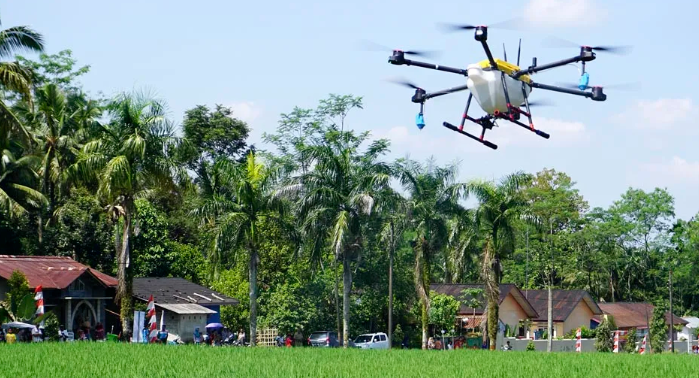
At the same event, Junior Researcher Lidia Kristina Panjaitan introduced an innovative drone sprayer propeller design tailored for use on Batu Ijo and Birma onion varieties. Her work focused on ensuring that the downwash effect from drone propellers does not damage plants while maintaining efficient fertilizer application. Using Computational Fluid Dynamics (CFD) aerodynamic simulation, she developed a hexarotor configuration with an NACA 4415 airfoil, eight blades, and a 66% throttle setting, powered by 870 watts and generating more than 200 Newtons of thrust.
Tests revealed that the optimal spraying altitude is 2 meters, which allows for uniform fertilizer distribution without harming shallot leaves. “With this design, the drone sprayer can accelerate fertilizer distribution while reducing labor costs,” said Lidia.
Through these combined advancements in biotechnology and digital agriculture, BRIN seeks to strengthen Indonesia’s agricultural resilience by improving productivity, reducing costs, and minimizing environmental impact. The agency continues to pursue innovative solutions that contribute to sustainable food systems and long-term national food security.