Titled “Investment opportunities for utility-scale solar and wind areas: Georgia zoning assessment,” the report employs a zoning methodology to identify optimal locations for renewable energy projects. Requested by the Georgian government, the study was supported by the Ministry of Economy and Sustainable Development and the Georgian State Electrosystem to inform national infrastructure strategies.
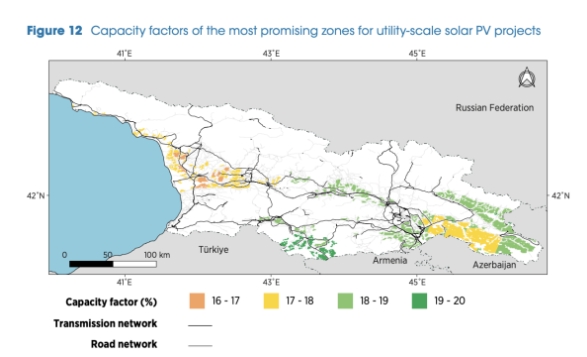
The report identifies prime areas for solar development, particularly in Georgia’s central, southern, southwestern, and southeastern regions, with the eastern part noted as especially favorable. These zones are strategically located near existing transmission and road networks, facilitating project implementation. The assessment details technical and economic factors, including potential installed capacities, hourly and annual energy output, localized electricity costs, and proximity to transmission infrastructure.
The 87 GW solar potential is based on a land-use footprint of 50 MW per square kilometer, a maximum of 5 GW per zone, and a land utilization factor of 20% to 30%. IRENA emphasized that the estimate serves as a starting point, encouraging further detailed studies using high-resolution data to pinpoint specific sites. The report noted limitations, such as not accounting for permitting requirements, land ownership, or protected areas, suggesting caution in interpreting the maximum figure.
IRENA’s findings indicate that Georgia could expand its renewable energy ambitions. The country currently targets 5.289 GW of renewable capacity by 2030, according to the 2024 Global Energy Monitor. By the end of 2024, Georgia had installed 133 MW of solar capacity, an increase from 64 MW in 2023, per IRENA’s data.
The report’s insights are expected to support Georgia’s efforts to enhance its renewable energy infrastructure. By mapping favorable zones and providing techno-economic data, it offers a foundation for targeted investments and policy decisions, positioning Georgia to strengthen its role in the global transition to clean energy.