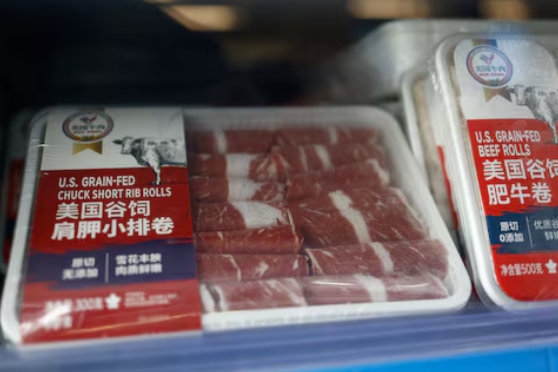
Packs of frozen beef rib rolls imported from U.S. are pictured at a supermarket in Beijing, China April 9, 2025.
The investigation responds to a surplus in the domestic beef market, driven by slower demand in China, the world’s largest market for beef imports and consumption. The ministry emphasized its commitment to maintaining a “healthy and stable” global trade environment through open communication with all stakeholders. The inquiry does not focus on any specific country, though major suppliers like Argentina, Australia, and Brazil could be affected by future trade measures.
Even Rogers Pay, an agriculture analyst at Trivium China, commented: “It’s definitely a relief to beef exporters. The extension buys Beijing a few months to see whether the domestic industry can regain profitability without safeguards, and hopefully to make progress on other issues with major beef exporters.” While trade restrictions like quotas remain a possibility, Pay suggested that quieter resolutions are more likely.
China’s beef industry has faced challenges, but recent efforts have shown progress. In July, an agriculture ministry official noted that beef cattle farming had been “generally profitable” for three consecutive months, supported by financial measures to bolster the sector. In 2024, China imported a record 2.87 million metric tons of beef, though imports for the first half of 2025 fell 9.5% to 1.3 million metric tons compared to the previous year.
Separately, the U.S. Meat Export Federation highlighted challenges with market access. Joe Schuele, a spokesperson, stated: “The vast majority of our plants aren’t eligible to ship to China presently.” He noted that the investigation is secondary to the urgent need to renew registrations for U.S. beef facilities, which expired in March. Without access to China’s market, the U.S. beef industry faces estimated annual losses of approximately $4 billion.
Dan Halstrom, president of the federation, emphasized the importance of consistent market access, saying: “Consistent and transparent plant approvals, without expiration, were among the most important components of the 2020 Phase One Agreement with China. It’s time for China to return to those commitments.” The extended investigation period offers a window for dialogue, as China balances domestic industry support with global trade considerations.