“This study introduces a vehicle-to-grid (V2G)-enhanced operation optimization strategy for EV charging stations with PV and energy storage (ES) integration,” the team said. “A day-ahead power purchase planning model based on two-stage distributionally robust optimization (TDRO) is established, demonstrating advantages in balancing economic efficiency with uncertainty risks. To address intra-day stochasticity, a model predictive control (MPC) based real-time optimization scheduling method for the EV charging station is proposed.”
The strategy was evaluated through a case study in Shanghai. It takes into account the variability of PV generation and the randomness of EV load, applying both day-ahead and intra-day optimization. The TDRO is designed to plan electricity purchases in two stages: the first uses PV generation forecasts, time-of-use pricing, and estimated battery state of charge (SOC); the second refines the plan by considering forecast errors. The MPC-based scheduling model then optimizes operations in real time, using a 15-minute interval to balance efficiency and responsiveness.
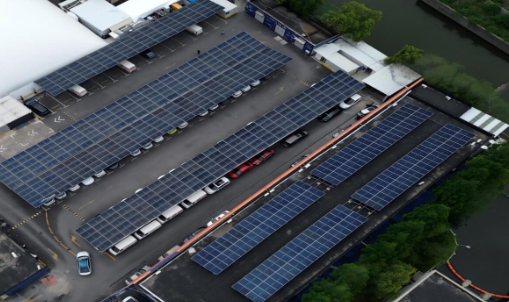
The case study involved an EV charging station in Shanghai equipped with 80 direct current (DC) fast charging piles, each rated at about 100 kW. PV panels with a total capacity of 500 kW are installed on parking canopies, supported by two six-slot battery containers with a combined capacity of 1,080 kWh. The research used EV load data collected between July and August 2024, covering 19,570 vehicle trips.
The analysis showed that the optimization strategy reduced operational costs significantly. On two representative days, the savings reached 17.80% and 13.51% compared to disordered charging. The researchers also highlighted the role of V2G in peak load reduction. “Joint optimization through V2G and ES can better reduce peak loads compared to using ES alone,” they explained. For example, with a peak demand of 2,608.96 kW during weekday evenings, PV-ES optimization reduced the peak by 11.57%, while PV-ES-EV optimization achieved a 23.81% reduction.
The results demonstrate the potential of integrated PV, ES, and V2G systems to lower costs, enhance flexibility, and reduce grid stress. The findings were published in the International Journal of Electrical Power & Energy Systems under the title V2G-enhanced operation optimization strategy for EV charging station with photovoltaic and energy storage integration. Academics from China’s State Grid Shanghai Municipal Electric Power Company and Nari Technology also contributed to the study, reflecting strong collaboration in advancing EV charging infrastructure.