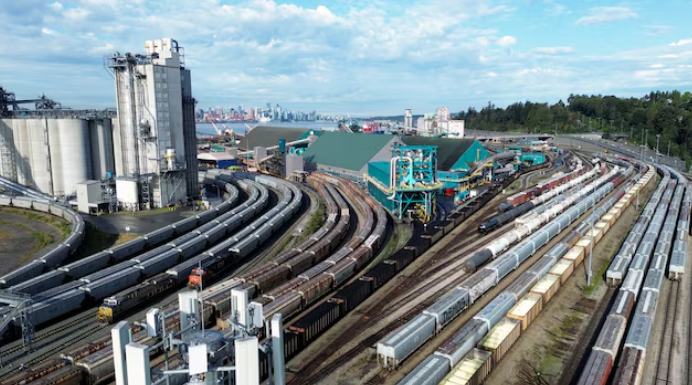
A drone view shows freight rail cars sitting in a Canadian National Railway Co. yard in North Vancouver, British Columbia, Canada August 22, 2024.
Earlier this month, U.S. President Donald Trump announced an additional 10% tariff on Canadian goods, raising the total tariff rate to 45%, following the 35% already imposed in August. The North American trade environment has been further strained by sector-wide tariffs of 50% imposed this year on steel and aluminum imports from multiple countries, affecting cross-border industrial supply chains.
In a statement, Canadian National Railway said: “CN has been adjusting its unionized and management headcount across Canada and the U.S. to reflect the business environment.” The company did not disclose the exact number of affected employees. Reuters noted that it could not immediately confirm the total number of layoffs.
Canadian National Railway operates an extensive network connecting Canada’s eastern and western coasts to key regions in the U.S. Midwest and Gulf Coast, serving as one of North America’s main freight transportation corridors. The reduction in management staff is part of CN’s broader effort to adapt to lower freight demand and ongoing market uncertainty.
The company is scheduled to release its third-quarter financial results on October 31. In its second-quarter report, CN withdrew its performance forecast for 2024–2026, citing elevated macroeconomic uncertainty and volatility arising from changes in global trade and tariff policies. Management noted that fluctuating trade dynamics have created unpredictable market conditions, making it difficult to issue reliable medium-term guidance.
CN’s freight volumes have been affected by weaker exports and slower industrial activity, particularly in sectors sensitive to tariff changes. The company continues to monitor economic trends and adjust its operational strategies accordingly to maintain financial stability and service reliability.
Despite current challenges, CN remains focused on infrastructure modernization, operational efficiency, and maintaining its core freight services across North America. The railway’s long-term strategy emphasizes flexibility in adapting to shifts in global trade and maintaining the efficiency of North American supply chains.
The recent workforce adjustment underscores the impact of trade-related disruptions on the broader logistics and transportation industry. As CN prepares its third-quarter results, investors and analysts are expected to closely assess the company’s cost-control measures and its outlook for the remainder of the year.