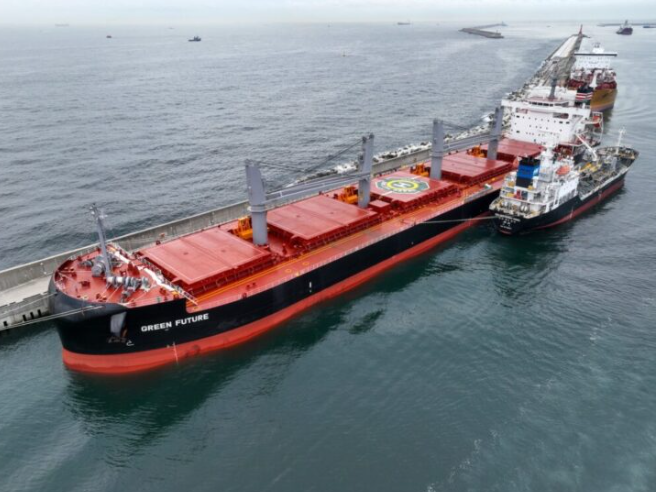
This development follows Ulsan Port’s world-first demonstrations of methanol bunkering for container vessels in 2023–2024, extending the port’s sustainable fuel capabilities to bulk carriers. The operation was conducted for the Green Future, a dual-fuel bulk carrier chartered by NYK Bulk & Projects Carriers Ltd., a subsidiary of the NYK Group, from Kambara Kisen Co., Ltd.
Green methanol, supplied by ITOCHU Corporation and produced by OCI Global, was transferred via ship-to-ship (STS) bunkering using storage at the OTK Terminal. The process utilised infrastructure at Ulsan New Port’s Southern Breakwater T/S Pier, marking the first STS green methanol bunkering for a dry bulk vessel in Korea.
UPA President Jae-young Byeon commented: “This bunkering operation is a milestone that demonstrates Ulsan Port’s capability to deliver commercial-scale green methanol bunkering. Building on this achievement, we are committed to spearheading sustainable marine fuel bunkering as a trusted global hub.”
The operation underscores Ulsan Port’s growing role in advancing sustainable marine fuel adoption. By enabling bulk carriers to access green methanol, the port supports decarbonisation efforts in shipping while expanding the commercial availability of alternative fuels in the region.
The successful bunkering is expected to encourage broader adoption of green methanol in the dry bulk sector, complementing earlier initiatives focused on container vessels. Ulsan Port has positioned itself as a regional leader in sustainable fuel provision, combining technical expertise, port infrastructure, and strategic partnerships to promote cleaner maritime operations.
Green methanol, produced from renewable sources, offers a lower-carbon alternative to conventional marine fuels, aligning with global efforts to reduce greenhouse gas emissions in shipping. The operation highlights the potential for dual-fuel vessels to integrate alternative fuels into their operations without compromising efficiency or reliability.
This milestone comes as global ports and shipping companies increasingly explore decarbonisation solutions. For instance, Associated British Ports (ABP) recently celebrated the success of its ‘TURBO-METH’ clean technology project, which secured funding through the UK Department for Transport’s Clean Maritime Demonstration Competition (CMDC 6). Initiatives like these demonstrate the growing international momentum for sustainable marine fuels.
With the completion of this operation, Ulsan Port Authority strengthens its position as a hub for alternative marine fuels, supporting the maritime sector’s transition to lower-emission operations. The port’s capability to conduct commercial-scale green methanol bunkering is expected to attract further investments and partnerships, reinforcing South Korea’s role in global sustainable shipping.