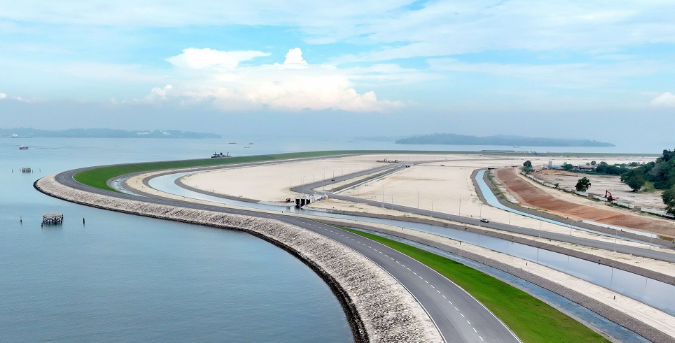
It’s Singapore’s first use of the empoldering method, which creates dry land below sea level by enclosing an area with a dike and keeping it dry with pumps and drainage systems
The empoldering approach is more resource-efficient than traditional reclamation methods, using up to 50% less sand, which reduces both costs and environmental impact. At the core of the polder is a 10-kilometer coastal dike with foundations set 1.2 meters below mean sea level. The dike rises to six meters above sea level and is designed to be height-adjustable to address future sea-level increases. A road along the dike’s crest provides maintenance access, supplemented by 21 kilometers of internal roads.
Singapore’s heavy rainfall and the low elevation of the site require advanced water management. The polder includes a 116-hectare stormwater collection pond with a capacity of five million cubic meters, equivalent to 2,000 Olympic-sized swimming pools. Two pumping stations and a 45-kilometer drainage network with over 30 water control structures manage excess rainwater, directing it to the pond during wet periods and pumping it to the sea once thresholds are reached. In dry periods, water is recirculated to maintain quality and prevent stagnation.
The project was implemented with guidance from the Netherlands, leveraging its global expertise in dike and polder engineering. Singapore’s Housing and Development Board and Public Utilities Board collaborated to ensure safety and efficiency. Officials highlight that the polder project reflects the country’s focus on innovation, sustainability, and resilience in long-term land reclamation and coastal protection.
Beyond supporting military training, the polder contributes to Singapore’s strategic planning for future urban expansion while preparing for climate change and rising sea levels. By combining efficient land use, advanced water management, and internationally proven engineering techniques, the project sets a benchmark for sustainable reclamation in regions with limited space and high environmental sensitivity.
The Pulau Tekong polder demonstrates how Singapore is addressing land constraints while balancing environmental and operational considerations, providing a model for future projects that aim to maximize land availability in an efficient and resilient manner.