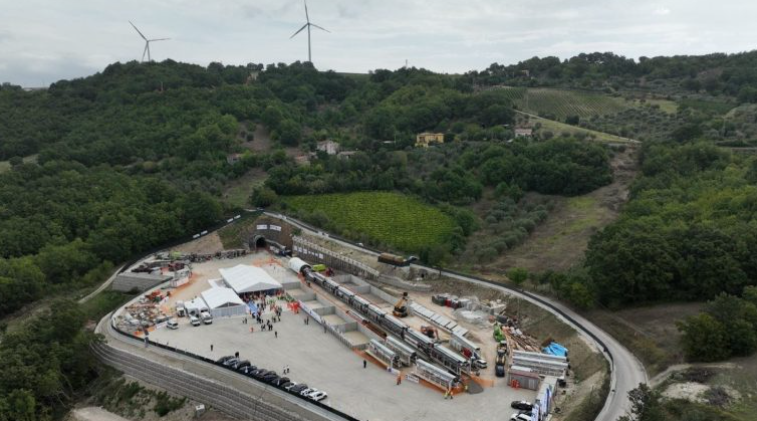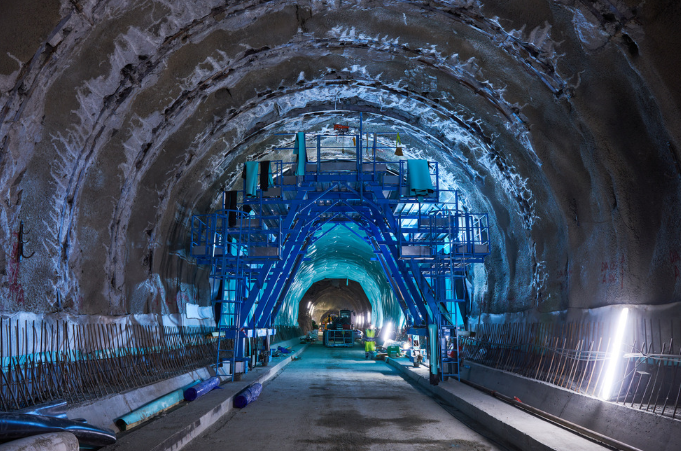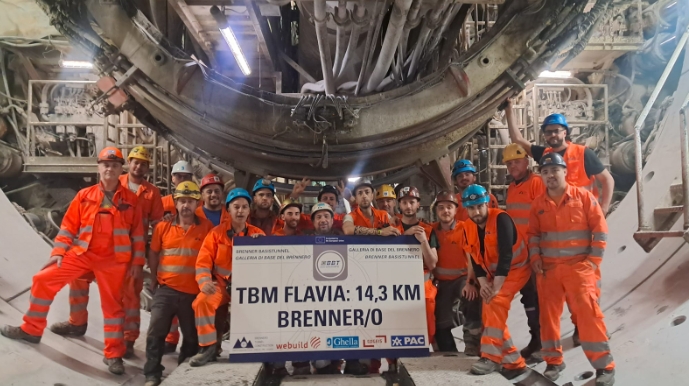
The tunnelling team at the border with TBM “Flavia”
Once completed, the tunnel will enable passenger trains to travel at speeds up to 250 kilometers per hour, reducing the journey time between Fortezza and Innsbruck from 80 minutes to 25 minutes. The tunnel passes beneath the Brenner Pass, which marks the border between Italy and Austria. Webuild reported that progress on the Italian side, known as Lot Mules 2–3, has reached over 95% completion.
Webuild is also contributing to the Austrian side of the project, working on the Gola del Sill-Pfons Lot and having previously completed the Tulfes-Pfons Lot. Additionally, the consortium constructed the Isarco Underpass, the southernmost point of the tunnel before it connects to the Fortezza station. The Brenner Base Tunnel forms a vital component of the Scandinavian-Mediterranean Corridor within the EU’s Trans-European Transport Network (TEN-T), facilitating connectivity by overcoming the Alpine barrier.
The breakthrough by TBM Flavia represents a key step in enhancing cross-border rail infrastructure. The tunnel’s high-speed capabilities will improve travel efficiency, supporting sustainable transportation between Italy and Austria. By reducing travel times and increasing capacity, the project is expected to boost regional connectivity and economic activity.
A spokesperson for Webuild stated: “The breakthrough with TBM Flavia is a testament to the dedication and expertise of our team, advancing a project that will transform rail travel across the Alps. This milestone brings us closer to delivering a sustainable, high-speed connection between Italy and Austria.”
The Brenner Base Tunnel project underscores the importance of collaborative engineering in addressing complex geographical challenges. Webuild’s work on both sides of the border highlights its role in delivering critical infrastructure for Europe’s transport network. The tunnel’s completion will mark a significant advancement in sustainable mobility, aligning with broader goals to enhance regional integration and reduce carbon emissions through efficient rail travel.