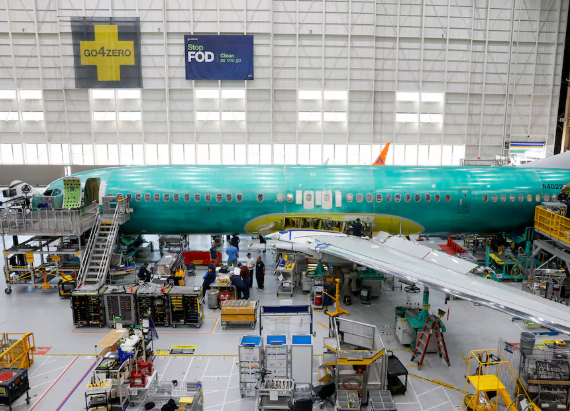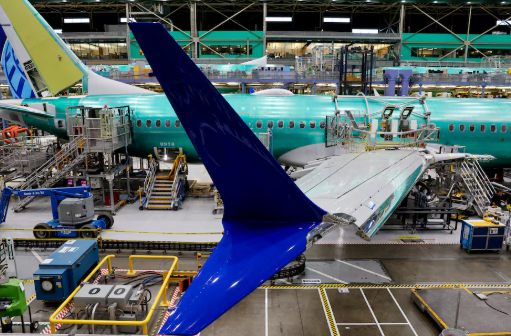
A Boeing 737 MAX aircraft is assembled at the company's plant in Renton, Washington, U.S. June 25, 2024.
From January to September, Boeing delivered a total of 440 airplanes, compared with Airbus’ 507 during the same period. The U.S. manufacturer continues to focus on recovering production levels across its commercial programs as market demand for new aircraft remains strong.
In September, Boeing handed over 40 of its 737 MAX jets, including 10 to Ryanair, one of which marked the company’s 2,000th 737 MAX delivery. The planemaker also delivered one 737 Next Generation aircraft for conversion into a P-8 patrol aircraft for the U.S. Navy, along with 14 widebody planes—four 767s, three 777 freighters, and seven 787 Dreamliners. Eight aircraft were delivered to Chinese customers, comprising a 777 freighter, a 787, and six 737 MAX jets.
Boeing’s September performance included 96 new orders. These comprised 30 737 MAX aircraft for Norwegian Airlines, 50 787s for Turkish Airlines, and 14 787s for Uzbekistan Airways. The company also reported two additional 737 MAX orders from an unidentified customer. Enter Air canceled one 737 MAX order, bringing Boeing’s net total for the month to 95 new aircraft after cancellations and conversions.
After accounting for adjustments, Boeing’s backlog declined slightly from 5,994 to 5,987 aircraft, reflecting a stable order book despite recent supply chain and certification challenges. The company continues to prioritize the delivery of its 737 MAX and 787 programs, aiming to meet growing customer demand in global aviation markets.
Earlier in the week, U.S. Treasury Secretary Scott Bessent said that communications between Washington and Beijing had helped ease tensions following reports that U.S. President Donald Trump had threatened to impose export controls on spare parts for Boeing aircraft. According to Bessent, “substantial communications” over the weekend contributed to stabilizing trade discussions between the two sides.
Boeing’s delivery data came as Wall Street closed mixed on Tuesday, with the Dow Jones Industrial Average rising by more than four-tenths of a percent. Industry analysts said Boeing’s latest results signal gradual improvement in its production and delivery performance, supported by continued recovery in international air travel and demand for fuel-efficient aircraft. The company remains focused on strengthening its supply chain and meeting its delivery targets for the remainder of the year.