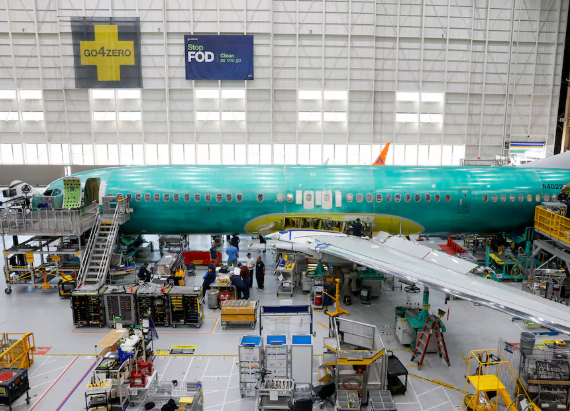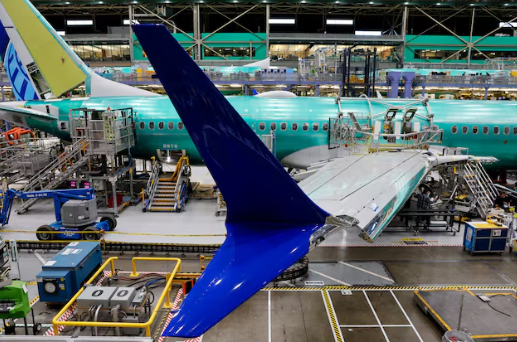
A Boeing 737 MAX aircraft is assembled at the company's plant in Renton, Washington, U.S. June 25, 2024.
The FAA had imposed the production limit following a 2024 mid-air emergency involving an Alaska Airlines (ALK.N) 737 MAX 9, in which missing bolts in a door plug caused a fuselage opening at an altitude of 16,000 feet (4,900 meters). The incident led to extensive inspections of Boeing’s manufacturing processes. On Friday, the FAA stated that its safety inspectors “conducted extensive reviews of Boeing's production lines to ensure that this small production rate increase will be done safely.”
FAA Administrator Bryan Bedford informed Boeing CEO Kelly Ortberg that the company could proceed with the production increase, according to a source familiar with the matter. Boeing plans to implement the new rate promptly. Workers at the manufacturer’s Seattle-area plants have been preparing for the ramp-up by installing additional equipment to expand production capacity.
Boeing expressed its appreciation for the support of its employees, suppliers, and the FAA, stating that the company is committed to “increasing production with safety and quality at the forefront.” Boeing shares rose 1.2% in after-hours trading following the announcement.
The 737 MAX is Boeing’s most popular single-aisle aircraft, and accelerating its deliveries is essential to improving cash flow. Planemakers typically receive most of their payments upon delivery, making production stability vital for Boeing’s financial recovery after several years of losses and high debt. The company currently holds $53 billion in debt, compared with about $12 billion in 2018.
Industry analyst Glenn McDonald noted that Boeing has previously produced more than 50 737s per month, but the global supply chain remains under pressure. He said that challenges such as limited availability of forgings, castings, engines, and interiors persist, though current issues are more sporadic than systemic. A factory fire earlier this year also disrupted Boeing’s supply of specialized fasteners. “Boeing seems to be better prepared for this ramp up than they have been for previous ones,” McDonald said.
Boeing has taken a cautious approach to restoring production under strengthened FAA oversight. It has built substantial inventories of parts and materials to prevent disruptions, holding $11 billion in raw materials as of the second quarter of 2025, compared with $6.4 billion in 2018.
Last month, the FAA also partially reinstated Boeing’s authority to issue airworthiness certificates for newly produced 737 MAX and 787 aircraft. Analysts expect Boeing to post losses this year but project a return to profitability in 2026 — its first since 2018.